Thursday, 31 May 2018

Chrome 67 is here, with password-free logins and improved VR

Chrome 67 is hitting desktops today, with support for password-free logins courtesy of Web Authentication (WebAuthn), plus improved support for sensors and virtual reality headsets.

WebAuthn is an open standard that lets you access your accounts using biometric data, a mobile app, or a portable device like a YubiKey. This can either replace passwords, or supplement them as two-factor authentication to make your accounts more secure.

It made its mainstream browser debut last month with the release of Firefox 60, and should be arriving in Microsoft Edge very soon. Apple has also pledged its support for the standard, though it hasn't specified when it might appear in Safari.

Its main appeal is protection from phishing attacks, because there's no fixed line of characters (like an alphanumeric password) that grants access.

Sensors and sensibility

It's not just security – Chrome 67 also adds support for several other technologies that'll help you have more fun on the web.

The browser now supports the Generic Sensor API, which enables web apps to use input from components including accelerometers and ambient light sensors. For example, a web app could display a 3D model, which you could see from different angles by rotating your device. That's something you can currently do in desktop apps, but hasn't previously been possible in Chrome.

There's also support for the WebXR Device API, which will make virtual reality experiences more consistent across different devices. That includes mobile-based VR headsets like Google Daydream View and Samsung Gear VR, and desktop-hosted headsets like Oculus Rift, HTC Vive, and Windows Mixed Reality Headsets.

It'll be up to web app developers to decide how to use the API, but Google suggests it could be used to improve immersive 360-degree videos, home shopping experiences, and 3D art installations.

Chrome 67 is available to download now for Windows, macOS and Linux.

Via ZDNet

https://ift.tt/2stgpRJ

Apple releases yet another High Sierra beta, while we still wait for macOS 10.13.5

Apple has released yet another beta update for macOS High Sierra, which will have the version number 10.13.6.

This is the fourth beta that Apple has released for High Sierra in May alone, which shows that the company is working hard on getting the new version of the operating system out to developers who have signed up for early builds.

The macOS High Sierra 10.13.6 beta has a build number of 17G31f, and it can be downloaded from the Apple Developer Center. A public beta for non-developers should arrive soon after.

Of course, with such an early beta version of the operating system, you should hold off installing it on any mission critical hardware.

Where’s macOS 10.13.5?

While this is the first beta for macOS 10.13.6, macOS 10.13.5 has had five beta builds. You’d have thought that after all those tests that Apple would have released a final version of 10.13.5, but so far it has not, with regular users still on macOS 10.13.4, which was released in April.

The fifth beta of macOS 10.13.5 included support for Messages in iCloud, which will allow Macs to work alongside the same feature in recent iOS betas.

This synchronizes the user’s messages between every device logged into the same iCloud account, with older messages stored online.

It sounds like a great feature, and we’re looking forward to giving it a go. We’re just waiting on Apple to provide the final version of 10.13.5.

Meanwhile, the release notes for macOS High Sierra 10.13.6 beta don’t provide any details about new features included in the upcoming release. This may be because it’s a very early beta build, and hopefully Apple will have some new goodies waiting for us in later builds.

Via Apple Insider

https://ift.tt/2J4oun6

Broadband and booze: Get a free case of wine with Virgin internet deals

Well this could get messy - Virgin Media is giving away a case of wine if you sign up for one of its selected broadband deals ending today. There are plenty of options to choose from with either 8 or 14 bottles of wine headed your way. Cheers!

Not a big wine drinker? Then not to worry, as Virgin broadband is also offering bill credit up to £100 as an alternative. So you can be teetotal and still get to benefit from Virgin Media's great internet promotion.

Head straight to the Virgin broadband website to see what options you can choose from. The long and short of it is that you have to get either a broadband and phone or broadband and TV package - broadband only deals aren't included.

So that means you could opt for the £29 per month Player TV Bundle for example, which comes with eight bottles or £50 bill credit along with average 54Mb internet speeds and 70+ channels. Or ramp things up to 108Mb speeds, 250+ channels (including BT Sport) and 14 bottles of vino or £100 bill credit with Virgin's Full House TV Bundle for £55 per month. That's to name but two.

Rather discuss your options over the phone? Then give 08000-492-102 a ring to speak to an adviser and order.

Is Virgin fibre broadband available in my area?

Around 60% of UK households are now able to receive super fast Virgin broadband. It's easy to discover whether you're one of the lucky 3-in-5 - head to our dedicated Virgin broadband deals page (or the price comparison chart at the bottom of this page), enter your postcode where indicated at the top of the page and if deals show as available then you're laughing.

If no results are returned, then head to our best broadband deals page instead and do exactly the same thing to see whether you can get superfast fibre broadband with another provider, such as BT Superfast.

Existing Virgin Media broadband customers

Sorry, the Virgin Media website confirms that the offer is for new customers only. If you're already with Virgin or have used the provider in your internet past, then you can forget the free wine and cry into your beer. Sorry.

https://ift.tt/2xuA9tX

Windows 10 April 2018 Update is rolling out twice as fast as Fall Creators Update

According to some fresh figures, the latest big update for Windows 10 is rolling out at a very fast pace indeed.

The stats from AdDuplex, which keeps an eye on the Windows user base via data collected from Microsoft Store apps, show that the April 2018 Update has been delivered to exactly 50% of Windows 10 PCs in one month flat.

That’s actually twice as fast as the previous Fall Creators Update, which took two months to get itself on half of all Windows 10 PCs. And the update before that – the Creators Update released just over a year ago – took no less than three months to reach the same stage of deployment.

All of which seemingly shows that Microsoft’s efforts to streamline the rollout process are working, although not everything is rosy, of course, given reports of forced updates being pushed out in some cases, not to mention the fair amount of problems we’ve seen with the April 2018 Update.

Those bugbears have included problems with Surface devices (of all things) and Alienware laptops, issues with SSDs, antivirus conflicts, and let’s not forget the mystery of the disappearing desktop – among other flaws (check here for our full troubleshooting guide if you have encountered any gremlins).

The various blocks that Microsoft has had to instigate to prevent rollout to certain machines, and the work needed to fix these problems, doesn’t appear to have impeded the pace of the rollout, evidently.

Surface statistics

Interestingly, AdDuplex also shared stats on the percentage of Microsoft’s Surface hybrids which are running the April 2018 Update. These show that around 65% of Surface Pro 4 owners, and over 70% of Surface Book and Surface Pro 3 users, have the new update.

All Surface devices have an adoption percentage of well over the 50% global average, as you might expect, except for the three-year-old Surface 3, and rather oddly, the more recently released Surface Laptop, which is stuck on 37% for some reason (which seems strange as it wasn’t one of the aforementioned Surface machines highlighted as having problems).

AdDuplex didn’t include the Surface Studio all-in-one in its report, because the firm said that the number of owners was just too small for any meaningful statistical interpretation to be made. It is, of course, a niche product from Microsoft, although from the sound of that, perhaps it’s even more sparsely sold than we thought…

https://ift.tt/2xvhjmv

4K HDR World Cup matches coming to BBC iPlayer – but there's a catch

Good news! You'll be able to watch the World Cup in 4K HDR thanks to the BBC and its iPlayer platform. Bad news! It's a limited trial run, meaning that it'll be serving up the Ultra HD football streams to a select number of viewers.

All 29 of the matches the BBC is broadcasting will be available in 4K, with the broadcaster hoping to deliver “tens of thousands” of high-resolution streams. Though 4K screens in homes aren’t quite as common as HD ones, there may still be some viewers left without access to the UHD content.

“The BBC has brought major live broadcasting breakthroughs to UK audiences throughout the history of the World Cup,” said Matthew Postgate, BBC Chief Technology & Product Officer.

“From the very first tournament on TV in 1954 and England’s finest hour in 1966, to the first colour World Cup in 1970 and full HD in 2006. Now, with these trials we’re giving audiences yet another taste of the future.”

The trial will be used to fine tune the delivery of large-scale 4K events in the future, with the Beeb making use of the Hybrid Log-Gamma version of HDR it helped to develop alongside Japanese broadcaster NHK.

You can find out if your screen is compatible with the Beeb’s 4K streaming option by clicking here.

Virtual reality action

It’s not just 4K getting some love from the BBC though – it’s also invested some money, time and development in delivering virtual reality content for the 2018 World Cup too.

The BBC Sport VR - FIFA World Cup Russia 2018’ app will be free on iOS, Android, Gear VR, Oculus Go and PlayStation VR platforms, and lets fans watch live matches from a “private box” in the Russian stadiums.

Live stats will pop out of a virtual coffee table too, while there’s also the option to watch the action from cameras placed behind each goal. In addition, when live coverage isn’t available, the app will continue to offer highlights and analysis.

All in all, despite holding its cards close to its chest in the run up to the tournament, it’s a comprehensive offering from the BBC. Just make sure to start those streams early if you want in on the 4K action.

  • The best 4K TVs: the best screens to watch the footy on
https://ift.tt/2spzxQP

Wednesday, 30 May 2018

Here’s Mary Meeker’s essential 2018 Internet Trends report

Want to understand all the most important tech stats and trends? Legendary venture capitalist Mary Meeker has just released the 2018 version of her famous Internet Trends report. It covers everything from mobile to commerce to the competition between tech giants. Check out the full report below, and we’ll add some highlights soon. Then come back for our slide-by-slide analysis of the most important parts of the 294 page report.

  • Internet adoption: As of 2018, half the world population, or about 3.6 billion people, will be on the internet. That’s thanks in large part to cheaper Android phones and Wifi becoming more available, though individual services will have a tougher time adding new users as the web hits saturation.
  • Mobile usage: While smartphone shipments are flat and internet user growth is slowing, U.S. adults are spending more time online thanks to mobile, clocking 5.9 hours per day in 2017 versus 5.6 hours in 2016.
  • Mobile ads: People are shifting their time to mobile faster than ad dollars are following, creating a $7 billion mobile ad opportunity, though platforms are increasingly responsible for providing safe content to host those ads.
  • Crypto: Interest in cryptocurrency is exploding as Coinbase’s user count has nearly quadrupled since January 2017
  • Voice: Voice technology is at an inflection point due to speech recognition hitting 95% accuracy and the sales explosion for Amazon Echo which went from over 10 million to over 30 million sold in total by the end of 2017.
  • Daily usage – Revenue gains for services like Facebook are tightly coupled with daily user growth, showing how profitable it is to become a regular habit.
  • Tech investment: We’re at an all-time high for public and private investment in technology, while the top six public R&D + capex spenders are all technology companies.

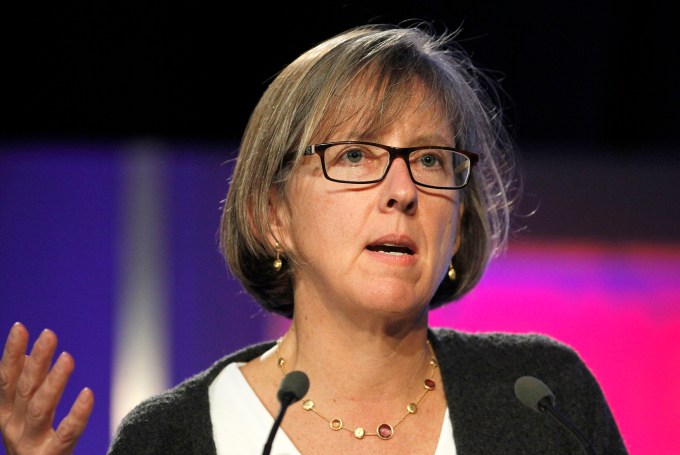
Mary Meeker, analyst with Morgan Stanley, speaks during the Web 2.0 Summit in San Francisco, California, U.S., on Tuesday, Nov. 16, 2010. This year’s conference, which runs through Nov. 17, is titled “Points of Control: The Battle for the Network Economy.” Photographer: Tony Avelar/Bloomberg via Getty Images

  • Ecommerce vs Brick & Mortar: Ecommerce growth quickens as now 13% of all retail purchases happen online and parcel shipments are rising swiftly, signaling big opportunities for new shopping apps.
  • Amazon: More people start product searches on Amazon than search engines now, but Jeff Bezos still relies on other surfaces like Facebook and YouTube to inspire people to want things.
  • Subscription services: They’re seeing massive adoption, with Netflix up 25%, The New York Times up 43%, and Spotify up 48% year-over-year in 2017. A free tier accelerates conversion rates.
  • Education: Employees seek retraining and education from YouTube and online courses to keep up with new job requirements and pay off skyrocketing student loan debt.
  • Freelancing: Employees crave scheduling and work-from-home flexibility, and internet discovery of freelance work led it to grow 3X faster than total workforce growth. The on-demand workforce grew 23% in 2017 driven by Uber, Airbnb, Etsy, Upwork, and Doordash.
  • Transportation: People are buying fewer cars, keeping them longer, and shifting transportation spend to rideshare, which saw rides double in 2017.
  • Enterprise: Consumerization of the enterprise through better interfaces is spurring growth for companies like Dropbox and Slack.
  • China: Alibaba is expanding beyond China with strong gross merchandise volume, though Amazon still rules in revenue.
  • Privacy: China has a big opportunity as users there are much more willing to trade their personal data for product benefits than U.S. users, and China is claiming more spots on the top 20 internet company list while making big investments in AI.
  • Immigration: It is critical to a strong economy, as 56% of top U.S. companies were founded by a first- or second-generation immigrant.


https://ift.tt/2LEoBYl

Starling Bank raising another £80M, ends partnership with TransferWise

Starling, the U.K. challenger bank founded by banking veteran Anne Boden, is in the early stages of raising a significant new funding round as part of plans to double down on its newly launched business current account, TechCrunch has learned.

According to a person familiar with the matter, Starling is looking to raise around £80 million in additional capital from new investors. To assist in the process, the company is hiring a new international advisory firm, pointing to an investor search that potentially goes beyond the U.K. and could include large international institutional investors. Up until now, Starling has been funded to the tune of £48 million by hedge fund manager Harald McPike, who, as a result, owns more than 50 per cent of the venture.

The need for Starling to increase its capital is thought to be related to the bank’s bid to be one of the recipients of the Capability and Innovation fund, which was set up by Royal Bank of Scotland to fulfil European state aid conditions arising from the bank’s £45 billion U.K. government bailout during the financial crisis. The fund will be split into different grants to help “challenger banks and other financial services providers” diversify and develop their business current account offerings for small and medium-sized enterprises.

Thought to be up against incumbents Santander, Metro Bank, Clydesdale Bank, and TSB, Starling is increasingly confident of winning the £120 million “Pool A” grant, which is being decided by an independent panel — not least if the fund is to meet its remit of genuinely increasing competition within SME banking. ( Starling’s Boden has been quite outspoken on the matter.)
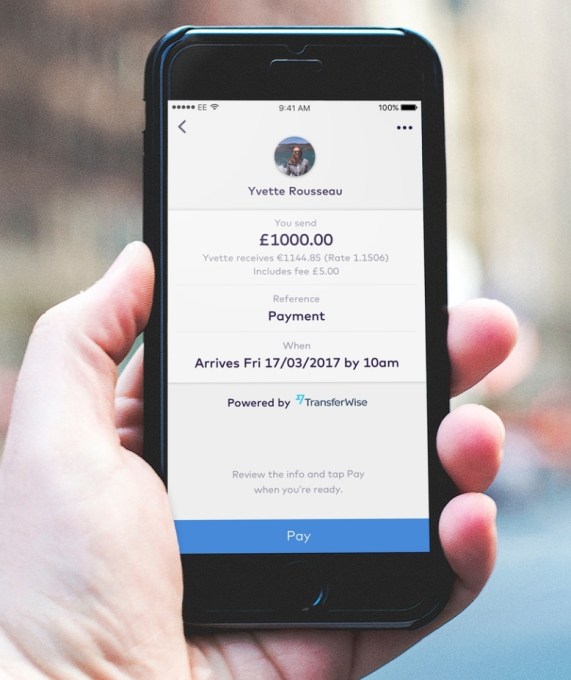
Starling and TransferWise integration as it might have looked

Related to this, Starling is busy recruiting a “double-digit” team for its SME banking unit. I understand from sources that executive search consultants have been engaged to work on senior hires and that this will include a new head of SME banking.

Meanwhile, Starling recently launched international payments within its consumer-facing current account, news it published on its blog and that was picked up in the fintech media. However, less well reported it that the bank has quietly dropped its previously announced partnership with fintech unicorn TransferWise.

Bank in March 2017, the two companies issued a joint press release detailing the partnership that would have given Starling customers “direct, in-app access” to TransferWise’s international money transfer service. The functionality was due to launch the following summer but never materialised (something that seemingly went unnoticed by most outlets). Now I understand the partnership has dissolved entirely as Starling has chosen to go it alone.

Asked what happened, TransferWise’s Head of Business, Stuart Gregory, issued the following statement:

“TransferWise is working with many banks to transform international payments for their customers, with more to come in the near future. In this instance Starling have chosen another route but it’s fantastic to see they’ve kept the price transparency of the real exchange rate and clear separate fees.”

Likewise, Starling’s Boden told TechCrunch: “Our partnership with TransferWise was always about meeting customer demands. As we developed out our payments business it became clear to us that integrating with a third party payments provider in the Starling Marketplace didn’t offer the best customer experience. We figured that we could provide a better user experience by doing it ourselves. As you know, Starling is all about customer service”.

Of course it’s never a good look when two companies announce with fanfare a major partnership that delivers nothing vapourware — Starling were still briefing that it was working with TransferWise in late 2017 — even if it is perfectly reasonable for both an upstart bank to switch strategy as the broader competitive climate changes. In this instance, since the original announcement, Starling has made significant headway on its own Starling Payments business, and TransferWise launched its own “borderless” banking product and debit card. Perhaps this is simply the case that partnering whilst increasing feature parity doesn’t always make for happy bedfellows.

https://ift.tt/2LIMLAV