Microsoft’s latest major update for Windows 11 hasn’t even been out for a month yet and it’s already causing issues for some businesses.
We’ve already reported on a printer bug that has plagued devices running the 22H2 update, but the company’s support site now suggests the update is causing problems for businesses looking to set up computers on behalf of their employees too.
As of October 6, Microsoft is investigating a problem that may cause provisioning packages not to work correctly. These are .PPKG files, which are typically used for configuring devices to work on business networks.
Windows 11 22H2 problems
Microsoft’s summary of the issue states that "Windows might only be partially configured, and the Out Of Box Experience might not finish or might restart unexpectedly.”
“Provisioning packages which are applied during initial setup are most likely to be impacted by this issue.”
Until it can patch this malfunction, Microsoft says: “if you can provision the Windows device before upgrading to Windows 11, version 22H2, this will prevent the issue”, however this is far from an ideal solution for companies that have already committed to the upgrade.
Last month, as mentioned, Microsoft also discovered that 22H2 was causing printers using the Microsoft IPP Class Driver or Universal Print Class Driver to resort to default settings.
With users unable to use printer-specific settings, like colour options, two-sided printing and print quality, Microsoft swiftly put a pause on signing 22H2 to affected users, and suggests that these users avoid manually upgrading to the latest version of its OS until a fix has been released.
Separately, the company is investigating issues for customers using remote desktop software, apparently also linked to the latest Windows 11 update.
Microsoft will hope it can put out the various fires quickly and that these are the last of the unwelcome surprises for Windows 11 users.
DoorDash is growing its delivery options with the new Drinks with DoubleDash allowing people to order food from one restaurant and alcohol from another at no extra cost.
This new feature comes a little over a year after the app introduced its DoubleDash service to the platform and alcohol delivery to the United States, Canada, and Australia. The company states it wants its platform to keep being a “one-stop shop for all local commerce needs”, and apparently the logical next step is to further interconnect its services. DoorDash also sees this as a way to help businesses grow more as it claims that local stores grew 130 percent after it introduced alcohol to its menu.
Drinks with DoubleDash is live now; all you have to do is update the app to get it. At this point, the feature is currently only available to users in the United States, according to a DoorDash spokesperson. We asked if there are plans to expand globally, but at the time of this writing, it looks like there aren’t.
(Image credit: DoorDash)
How it works
Looking at the sample video, the entire process looks straightforward. Once you place an order for a meal, you can then scroll down to the bottom to the alcohol section where you can peruse all the options available. Users can pick something out from their local “liquor, convenience, or grocery store.” Everything will go into a single cart and, as alluded to earlier, there are no additional delivery costs or fees. There’s not even a minimum order size.
Obviously, you will have to be at least 21 years old to use this service, which means you'll have to show your ID to the delivery driver (or Dashers as the company calls them). You do have the option to use dual ID verification, a security feature DoorDash added back in July. Essentially, Dashers can scan a customer’s ID with their DoorDash app to verify a person’s identity before handing off the delivery. The company claims it added this feature to help prevent underage drinking and "keep impaired drivers off the road."
Recent security troubles
Speaking of security, it's worth mentioning the recent phishing attack that hit DoorDash back in August. The company didn’t give an exact number of how many people were affected other than saying a “small percentage” of its user base was affected. DoorDash did reveal the data stolen included names, emails, phone numbers, payment card information, and even delivery addresses.
The company stated it didn’t find any evidence of that data being used for fraud, but the danger is still there. If this concerns you or you were affected, be sure to check out TechRadar’s recently updated list of the best identity theft protection software.
- Episode 7 (of 8), 'The Eye'
- Written by Jason Cahill
- Directed by Charlotte Brändström
★★★★
Full spoilers follow for The Rings of Power episode 7.
Fire will reign. It's a small but significant piece of promotional material that's been used for HBO's House of the Dragon. But, with The Rings of Power episode 7 – titled "The Eye" – dealing with the fiery fallout from the Prime Video show's sixth installment, it feels apt to borrow it. For one week, anyway.
Understandably, the latest episode in Amazon's Lord of the Rings isn't as high octane or shockingly climactic as its predecessor. However, The Eye is as dramatically tense, if not more so, than episode 6 – aka Udûn – was. It's a captivating entry that sows the seeds to set up a potentially grand season 1 finale, with events in the show's three main narratives seemingly coming to a head.
Although, with the Khazad-dûm and Harfoot storylines reintroduced after a week off, episode 7 finds the high fantasy series falling back into old, superfluous habits. That being that some plots are just simply less thrilling or currently important than others.
Apocalypse now
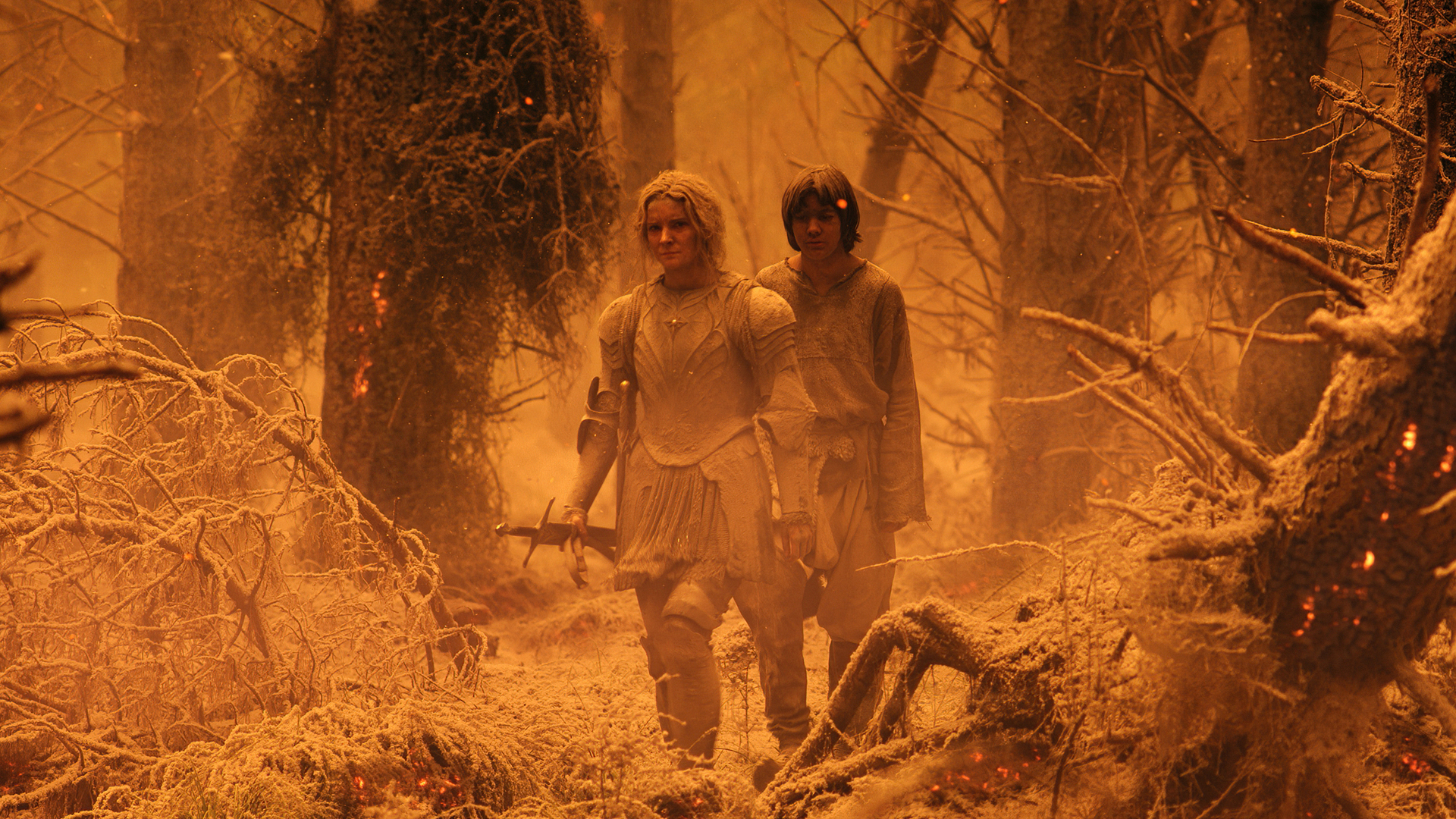
Ashes to ashes, dust to dust...(Image credit: Amazon Studios)
It's an eerie and dread-induced opening, with a dazed and traumatized Galadriel taking in the horrors around her following Mount Doom's eruption. The charred remains of Númenorean warriors and Southlands citizens, destroyed buildings, and ash litter the landscape. For someone who played some part in how this cataclysmic event unfolded – it's Galadriel's unwavering determination and stubbornness to track down Sauron that part fuelled it – the scene of devastation is sure to have a major impact on the elven warrior.
But there's no time to mourn the dead or deal with the repercussions of her actions now. Running into a stunned Theo, Galadriel leads him through the chaos swirling around them. A deliberately slow moving camera shot – director Charlotte Brändström's expert cinematic eye is on full show in this opening sequence – conveys the level of catastrophe in excruciating detail.
Amid the destruction, there's also a sense of deep, personal loss, too. A reunion between Isildur and Queen Regent Míriel, who work together to rescue Valandil from under a collapsed wall, is quickly punctuated by the revelation that Ontamo – Isildur and Valandil's friend – has perished. It's a devastating moment, with Maxim Baldry's dejection delivering a powerful summation of what we're witnessing in real time.
We need reminding of the threat the Stranger poses to the Harfoots, but it's a scenario we've seen a few times now
Like Galadriel, though, there's no time to grieve. Civilians are trapped in a nearby burning building, so the trio work together to rescue them – but at a great cost. Míriel's face is burned by embers, while Isildur is seemingly crushed when the building collapses around him.
Like episode 6's death fake out with Bronwyn, though, Isildur's apparent killing isn't as impactful as it should be, given the role he plays in Middle-earth's future down the line. Still, it's heartbreaking to see Míriel and Valandil deliver the news to Elendil later on, even if we don't actually see the pair utter the words of Isildur's alleged death.
And still the misfortune continues. As we soon learn, the embers that burned Míriel's face have actually blinded her; a moment that makes Míriel's "I see" comment hit particularly hard when the discovery is made.
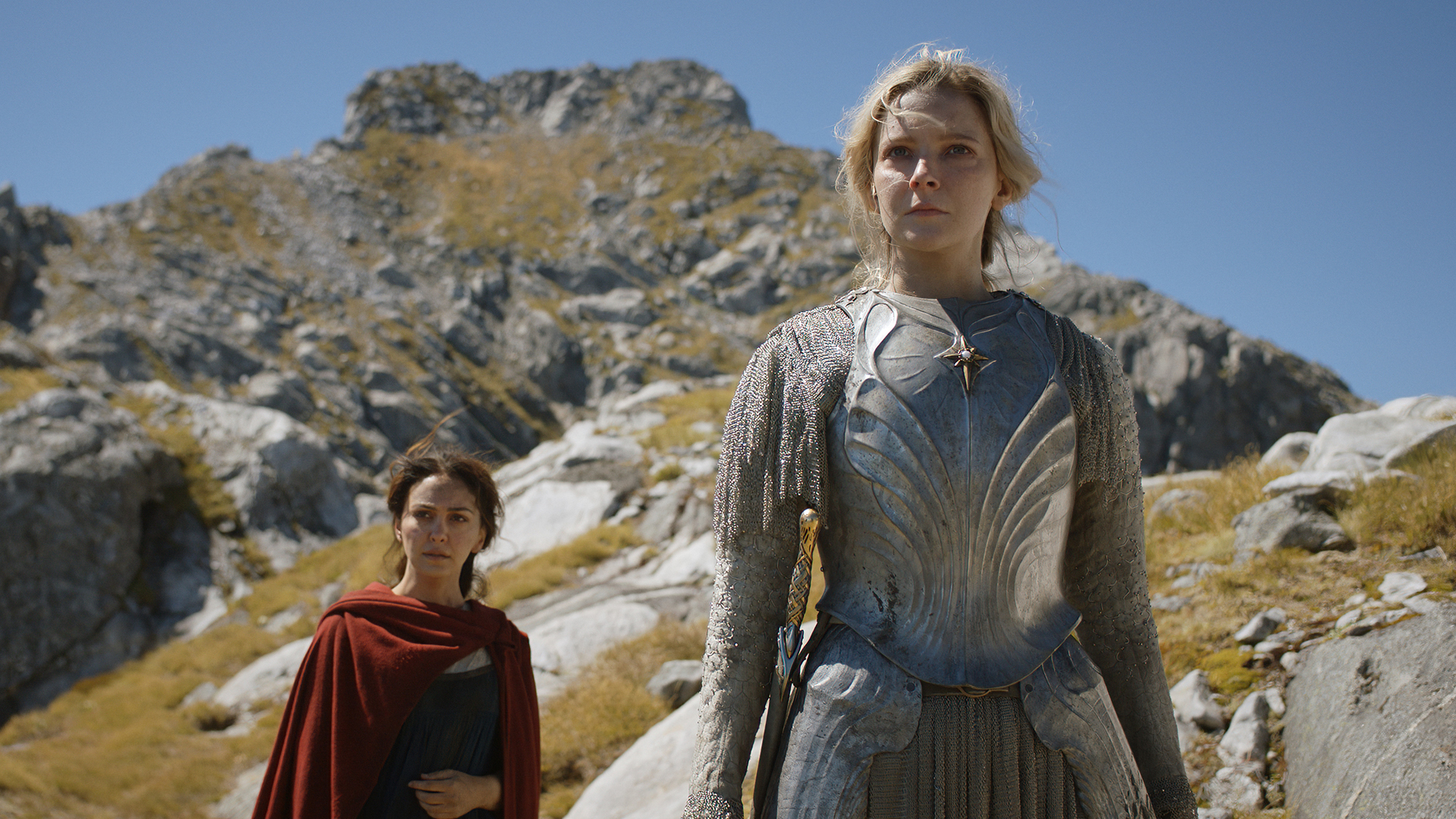
Galadriel's expedition to the Southlands is short-lived.(Image credit: Amazon Studios)
Meanwhile, Galadriel and Theo's rendezvous allows The Rings of Power to show how much the hot-headed elf has grown in her season 1 journey. She convinces a furious and spontaneous-thinking Theo not to engage in a suicidal mission to try and save his homeland. It's a scene that allows Theo to act as a mirror to the naive Galadriel we met in the series' premiere, a moment that puts her character development on full display.
Subsequent scenes between the pair perform a similarly admirable job, with the duo engaging in a heartening conversation later that night as they hide from an orc scouting party. The latter part of this sequence also feels heavily inspired by The Fellowship of the Ring movie scene where the Hobbits hide from the Ringwraiths.
It's the satisfyingly intimate chat between Galadriel and Theo, though, that takes center stage here. Well, until Galadriel drops a huge bombshell where casual Lord of the Rings fans are concerned. She didn't just lose Finrod to the orcs – she also lost her husband Celeborn. That's what she thinks anyway *hint hint*.
The pair make it to the Númenorean camp where, movingly, Theo reunites with Bronwyn and Arondir. A guilt-riddled Galadriel reconnects with a faith-stricken Elendil and blindfolded Míriel, the latter of whom defiantly vows Númenor will return to fight Sauron's forces once they've rested up at home. Her decision is like a dagger to Elendil's heart who, wracked by grief over Isildur's death – his horse Berick is surely going to find and rescue Isildur following his release – feels betrayed by his queen and Galadriel.
As the Númenoreans set sail for home, Bronwyn makes another fascinating revelation. The Southlanders plan to resettle in an old Númenorean colony on the great river Anduin called Pelargir. Interestingly, Pelargir becomes Gondor's main harbor after its founding in 2350 of the Second Age; a city built as a haven of the Faithful – i.e. those Númenoreans who remain loyal to the Valar and, by extension, the elves. Not a bad bit of Middle-earth lore tie-in, eh?
The Eye's final reveal comes in the form of Halbrand, who survived Mount Doom's eruption. However, as Galadriel (and we) soon find out, he's been severely injured and only elvish medicine can cure his wounds. Despite being in no condition to go anywhere, Galadriel elects to bring him with her to Lindon, where he can treated – and where she'll likely incur the wrath of High King Gil-galad. Prepare for some intense elven scenes in episode 8, then.
Going on another adventure
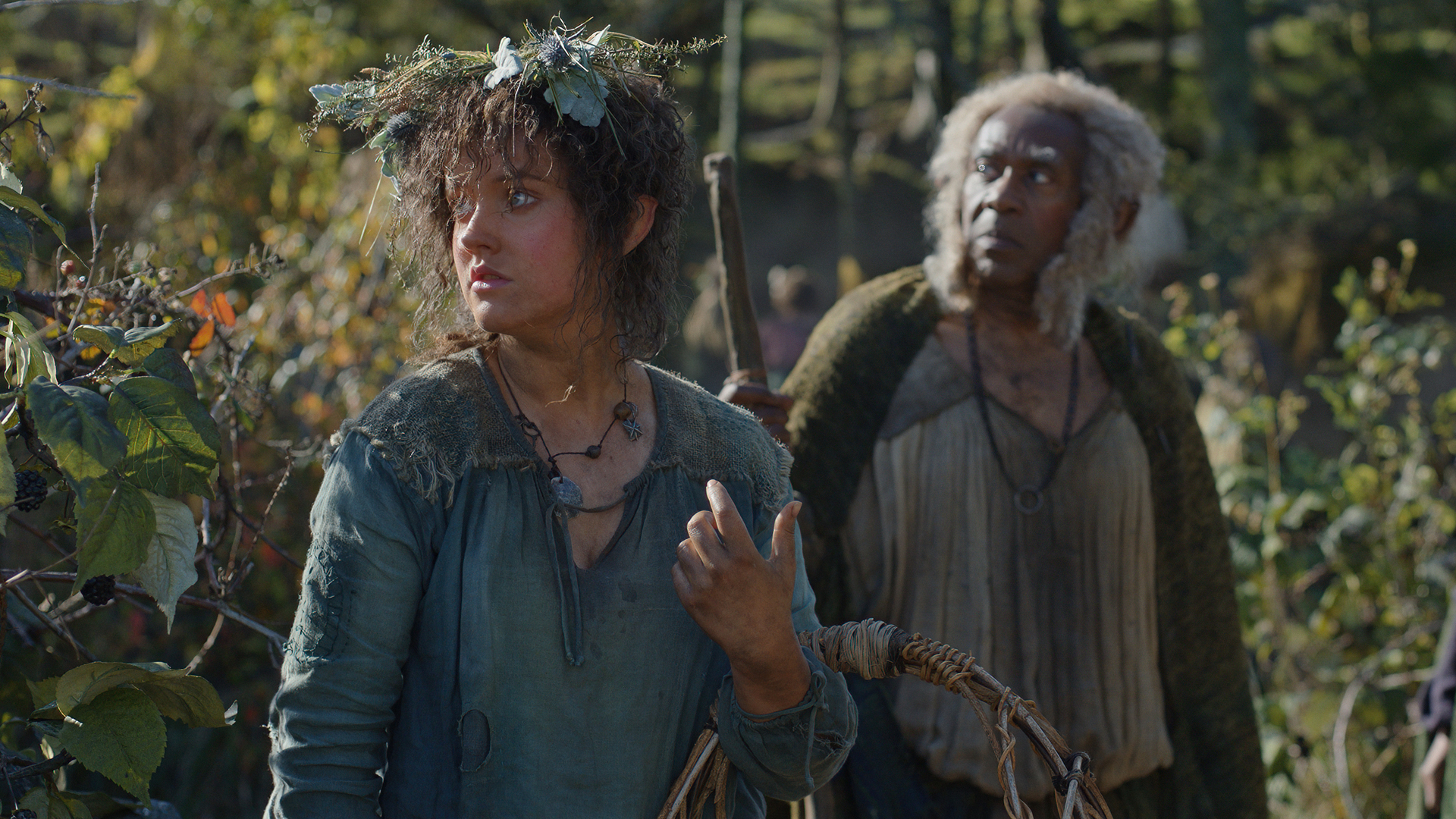
The Harfoots' storyline is full of twists and turns in episode 7.(Image credit: Amazon Studios)
Away from the Southlands, it seems that the Harfoots' storyline will bring so much needed levity to the show's seventh episode.
Except it doesn't. Cresting a hill as they reach the Harfoots' favorite grove, a shocked Nori and Poppy look down upon a torched landscape. Volcanic rocks from Mount Doom's eruption have rained down and destroyed the trees they rely on, meaning the harvest won't be so great this time around.
But Sadoc Burrows has a plan. He asks the Stranger to use his powers to revive one of the apple trees so the Harfoots have something to store away for the winter. The Stranger obliges but, when his trance-like abilities almost get Nori and her younger sister killed by a falling tree branch, the Harfoots quickly round on him.
It's a frustrating move from a narrative perspective. Sure, we need reminding of the threat the Stranger poses to the Harfoots, but it's one we've seen a few times now. Equally, it was Sadoc's request that persuaded the naive Stranger to help them – a move that almost gets Nori and her sister killed. Shouldn't the Harfoots be taking their anger out on Sadoc instead?
Owain Arthur, in particular, is an emotional powerhouse, with a performance that truly tugs at the heartstrings
Anyway, a decision to part ways with the Stranger is made. It's a wrench to watch, particularly after Sadoc and Nori gift him the star map and an apple for the journey.
But hope springs eternal. Waking the next morning, Nori sees the Stranger's spell has worked, with the Harfoots harvesting apples, and other fruit and vegetables, for their next migration.
Or so it seems. Fetching some water from a nearby stream, Poppy spots a giant footprint in the riverbank: the Mystics, the three-strong party comprising The Dweller, The Nomad, and The The Ascetic, have caught up with the Harfoots and, as night falls, they search for the Stranger's whereabouts.
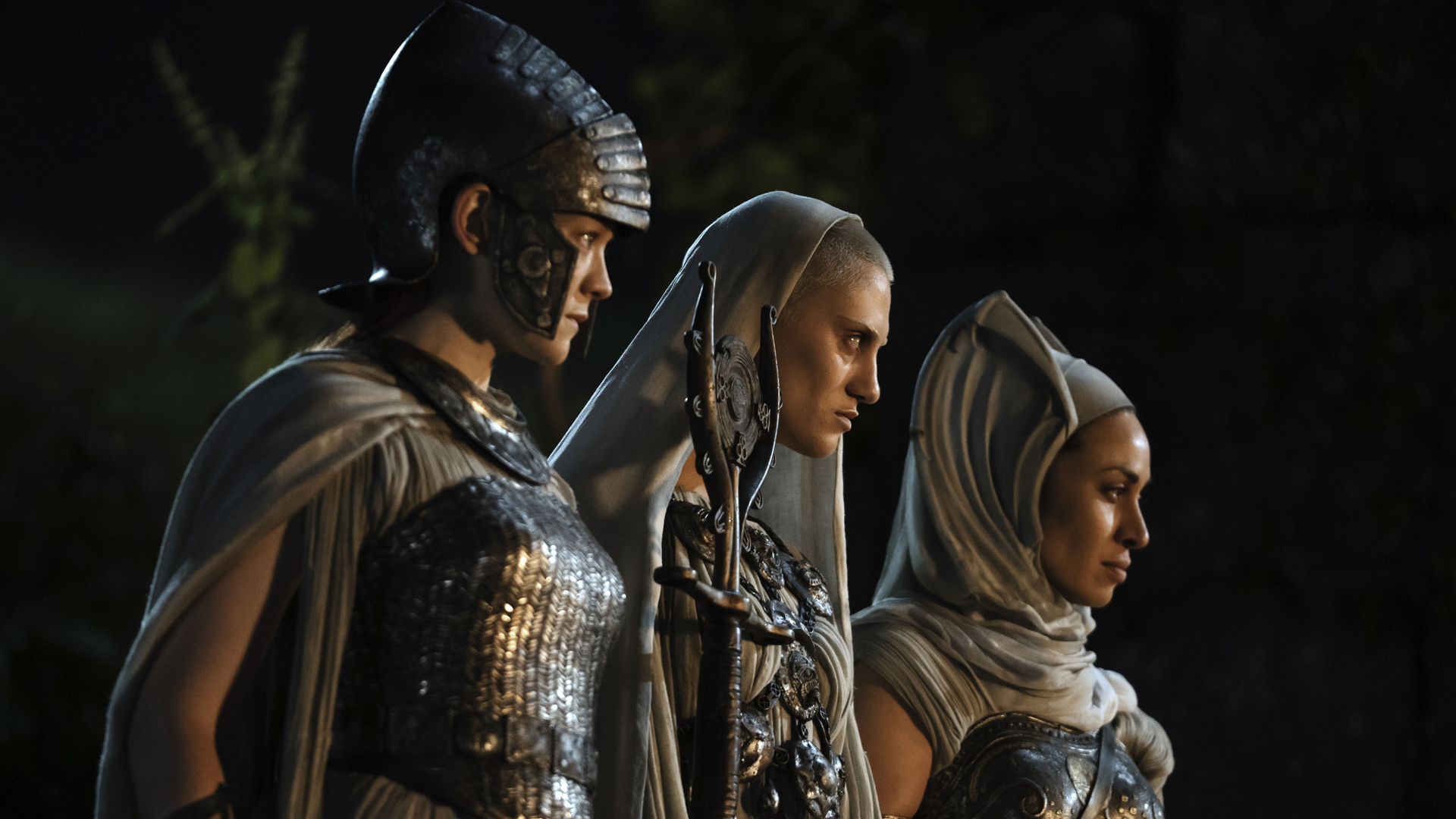
The Harfoots don't stand a chance against the Mystics.(Image credit: Ben Rothstein/Prime Video)
Nori tries to throw them off the trail but, as the Mystics demonstrate, their unholy supernatural abilities – they torch the Harfoots' caravans, after all – show how menacing they are. As long as the Stranger doesn't defeat them in the season 1 finale, the Mystics are primed to be major antagonists in season 2.
Despondent over how her actions continue to put the Harfoots in harm's way, Nori sulks while the others pick up the pieces. Largo, though, snaps her and the Harfoots out of their self-pitying stupor with an optimism-laden speech; a small but significant address that results in Nori vowing to search for the Stranger and warn him about the Mystics. But she won't be alone – Poppy and, in a really touching move, Nori's mom Goldie decide to join her. Oh, and Sadoc, whose arm is twisted into leading them as he's the only one with the off-trail knowledge to do so. It's a rare but no less pleasing bit of hope after what amounts to a pretty misery-laden episode overall.
Dwarven disasters
The Rings of Power's Khazad-dûm storyline is full of intense drama.(Image credit: Amazon Studios)
Over in Khazad-dûm, things are looking just as bleak for the elves and dwarves.
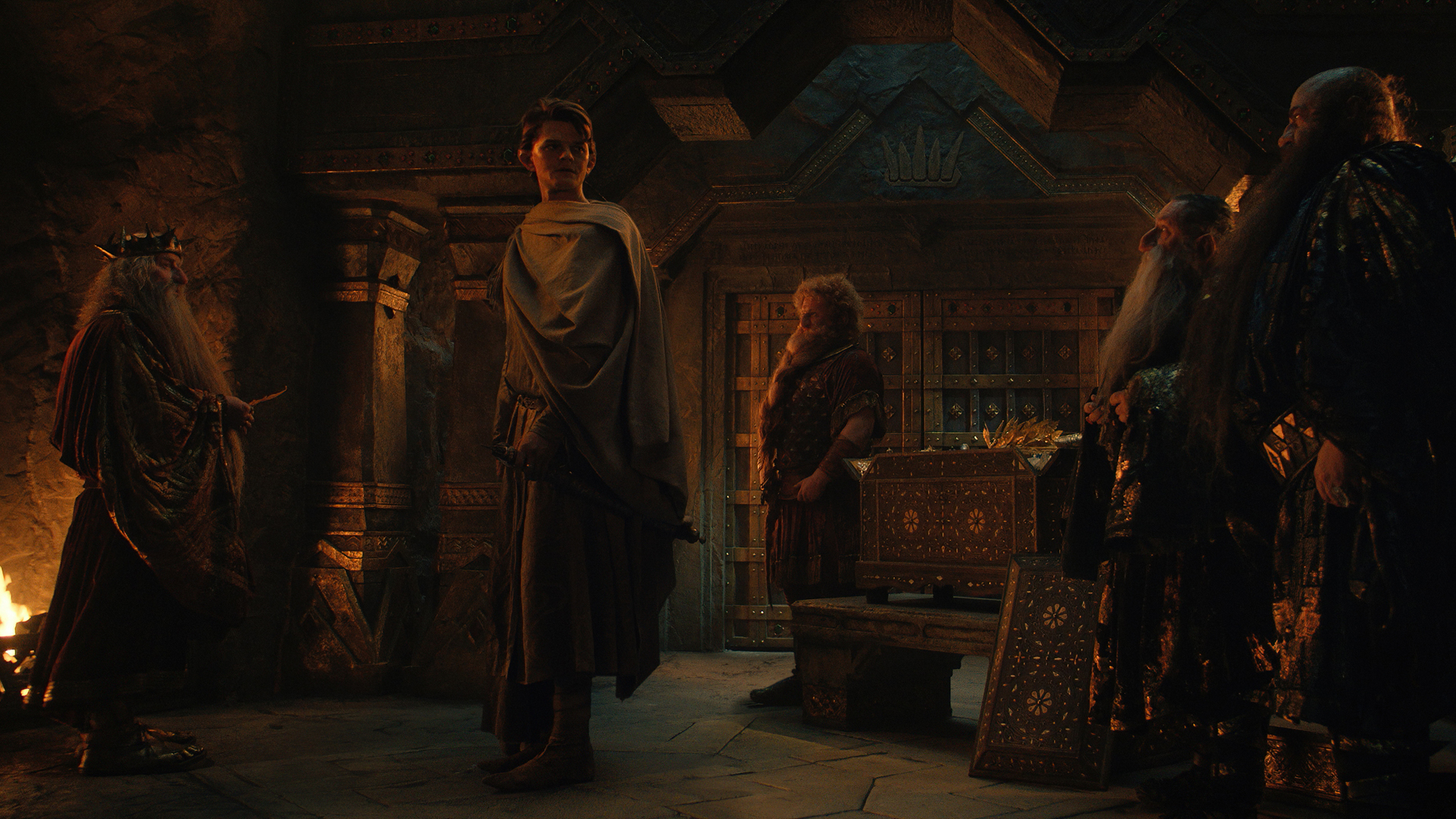
Elrond and Durin unsuccessfully convince Durin's father (and Khazad-dûm's king) to reopen the mithril mines to excavate the shiny ore in order to save the elves. A tense back and forth between the two Durins follows, with King Durin even going so far as to provide some telling foreshadowing to Khazad-dûm's eventual downfall. It's a nice, lore-specific reference that signals where the kingdom's future lies post-Second Age.
A downcast Durin delivers the bad news to Elrond, leading into a deeply poignant scene where the pair's faces say more than most words could. Robert Aramayo and Owain Arthur have brought plenty of sentimental gravitas to The Rings of Power throughout its first season, but this scenario dials that up to 11. Arthur, in particular, is an emotional powerhouse here – and in a later scene – with a performance that truly tugs at the heartstrings.
Inconsolable, Durin throws the piece of mithril, which he gifted to Elrond and is returned by the elf before his departure, towards the dying Lindon leaf that the duo tried to convince King Durin with. Instantaneously, the mithril cures the leaf of its ailment. Stunned, Durin and Disa determine to aid Elrond – even if it's against King Durin's wishes. Uh oh.
It's an eerie and dread-induced opening, with a dazed and traumatized Galadriel taking in the horrors around her in the aftermath of Mount Doom's eruption
Elrond and Durin conspire to dig for more mithril, engaging in a delightfully humorous chat that, like Galadriel's talk with Theo earlier, reveals a bit more about Durin's backstory. It turns out dwarves have secret names, though we don't actually learn what it is.
As the duo happen upon vast, awe-inspiring (or should that be ore-inspiring?) quantities of the mineral, though, King Durin arrives with armed guards, who arrest Elrond and cast him out.
An insightful expository piece concerning Prince Durin's birth – a story that also speaks to dwarven rituals and traditions – from King Durin follows. But it's a stirring misdirect as the Durins' father-son chat quickly erupts into an intense slanging match. It starts when Prince Durin suggests his mother (and King Durin's wife) would be proud to have Elrond as a son. Quietly seething, King Durin strips his son of his ceremonial collar, casting it to the ground before walking away. An emotional Prince Durin retrieves it, but his father tells him to "leave it", adding "it's not yours anymore". It's a cruel verbal blow that acts a metaphorical driving of a seemingly permanent wedge between the pair; one that might prove to be irreparable.
Crestfallen, Prince Durin laments to Disa, who reminds him that, one day, they will rule Khazad-dûm. In the mithril mines, King Durin tells his soldiers to seal the hole his son created, but not before he casts the Lindon leaf into the chasm below. Little does he know, though, that such an act seemingly wakes the Balrog, known as Durin's Bane from its slumber. Double uh-oh.
What we think
The Eye is another great entry in The Rings of Power's first season.(Image credit: Prime Video)
The Rings of Power episode 7 is an entry filled with its characters either pitying themselves (and one another) or wanting to tear each other's throats out. Given what occurred in episode 6, and what plays out in episode 7, it's arguably the most bleak installment in the series yet and, to some viewers, will feel like a return to the sluggish narratives that negatively impacted the show's flow in earlier episodes.
While it can't compete with Udûn as a visual spectacle, The Eye makes up for that with potent drama, deftly intimate moments, and genuine optimism for the future of each race, elves aside. Its season 1 finale set up is well executed, meaning we're in for a potentially engrossing episode 8 in a week's time.
Plot direction niggles aside, then, The Rings of Power's seventh episode makes for another largely riveting watch. Let's just hope that season 1's last installment lives up to expectations and leaves us with plenty to look forward to in its second season.
The Rings of Power episodes 1 through 7 are available now onPrime Video.
Xiaomi has begun rolling out its Q2 TV series in Europe, offering consumers an affordable way to access premium home entertainment features like Dolby Atmos and Dolby Vision.
The new Google TV-powered QLED display is available in 50-inch, 55-inch and 65-inch sizes, and with a fairly impressive list of features behind its pixels, Xiaomi’s latest TV could prove a tempting cheap alternative to more expensive mid-range QLED models from the likes of TCL and Samsung, which make some of the best 4K TVs for those a budget.
The catch, though, is that we don’t yet know when – or indeed if – the Xiaomi Q2 is heading to market in the US and UK. The 50-inch model starts at €700 in Europe, which would put it somewhere close to the $690 / £620 mark if Xiaomi maintained similar pricing globally. FlatpanelsHD also notes that a launch offer has knocked the Q2's European price down to just €550, which could translate to around $540 / £480 in overseas markets.
Should the range be expanded beyond the borders of Europe and China, the Xiaomi Q2 would serve as a worthy competitor to Amazon’s newly announced Omni Fire TV QLED, as well as to cheaper options from the big TV manufacturers.
Like the Xiaomi Q2, the Amazon Omni Fire TV QLED is positioned as an affordable QLED TV – it’s currently available to preorder for $799 (65-inch) and $1,099 (75-inch) in the US – but Xiaomi has added Dolby Atmos and DTS:X audio support to its latest offering, where Amazon has not.
The Xiaomi TV Q2 QLED series comes in 50-inch, 55-inch and 65-inch variations(Image credit: Xiaomi)
You’ll get three HDMI ports and Google TV interactivity from the Xiaomi Q2, too, where Amazon’s Omni Fire TV maintains the company’s Android-based Fire operating system (which is either a benefit or a drawback, depending on your fondness for Google’s software).
It’s not entirely clear what kind of image quality to expect more generally from the Xiaomi TV Q2 – unlike its Amazon competitor, its spec sheet doesn’t mention direct backlighting and local dimming, so it may be a more basic LCD offering.
However, Xiaomi does say to expect 92% DCI-P3 color gamut coverage from the TV, which will put it roughly on par with the likes of the Samsung Q60B for color reproduction – though behind even cheaper OLED TVs, such as the LG A2, which delivered 98.8% DCI-P3 color coverage in our tests.
Still, for what could end up being a $690 / £620 display, the Xiaomi TV Q2 checks a lot of boxes in the mid-range specs department, and could be especially tempting for anyone wanting to pair it with one of the best Dolby Atmos soundbars. Here’s hoping it hits shelves in more countries in the near future.
Uncertainty and change are driving workplace innovation, but also creating new headaches for businesses, a report from Adobe Document Cloud has claimed.
A survey of businesses across the US, UK, France, Germany, Australia, New Zealand, Japan and India revealed 70% of managers and employees agree that “change has become the new constant in the workplace”.
But despite fueling employee anxiety, 68% of SMB leaders and 77% of enterprise managers believe “constant uncertainty is forcing their business to find new ways to collaborate.”
The only certainty is uncertainty
The economy, politics, climate change, gun violence, and Covid-19. These are the top concerns of managers and employees across both enterprises and SMBs, Adobe’s Future of Time report revealed.
Those concerns have consumed the workplace, with 70% of managers and employees claiming to discuss current affairs more than they did last year. And that’s bad news for employees, 1 in 3 of whom reported that increased uncertainty has made it difficult for them to focus on work.
However, it’s not just employees who may fear being pushed to the edge. While 39% of employees are considering a new job in 2023, so are managers (41%) and small business leaders (34%). Among those who feel their employer isn’t aligned to their values, 52% admitted they may pursue a new job.
But it’s not all bad news - and it seems digital tools may hold the key to re-engagement.
According to Adobe, where companies have invested in digital solutions, employees were “twice as likely to say they have experienced better work-life balance as a result of innovation,” compared to firms lacking online collaboration and creation tools. And 20% said they’ve experienced greater efficiency and better working relationships with colleagues.
Business leaders have also witnessed similar results. 80% said they’ve observed “at least one benefit of increased innovation in the workplace, including higher productivity and higher efficiency.”
Responding to the concerns of those in the business, 71% of SMB leaders and 81% of enterprise managers believe their organizations will become increasingly digitized over the next year, to help employers and employees navigate uncertainty in the future.
Intel-powered laptops are at risk if a Linux update is applied, as the notebook display could be physically damaged.
This is one of those horror scenarios that PC owners dread, of course, and the update in question is the recently released version 5.19.12 of the Linux kernel.
Unfortunately, a bug in the graphics driver – for integrated Intel GPUs, this is – triggers a power sequencing issue which, as Phoronix reports, manifests as very fast white flashes happening on the screen. And as mentioned, these can potentially damage the panel, so this is a very serious hardware issue caused by a software flaw.
As you might imagine, action has been quickly taken, and Linux kernel developer Greg Kroah-Hartman promptly released Linux 5.19.13 where the faulty patches for the Intel graphics driver have been reverted.
Kroah-Hartman noted: “This release is to resolve a regression on some Intel graphics systems that had problems with 5.19.12. If you do not have this problem with 5.19.12, there is no need to upgrade.”
Only some distros are reported as having the issue, having upgraded to kernel 5.19.12, namely Arch, Fedora, and openSUSE Tumbleweed. Hopefully those distros will provide the fresh release in a swift manner.
Analysis: A worrying lapse that could be very costly
Going by user reports, some folks with Intel GPUs in their notebook have been unaffected by version 5.19.12, but others certainly have been hit. Perhaps the latter are in the minority, which might be a factor as to how this gremlin survived into the stable release.
It’s a worrying – and rare – lapse for Linux, of course, given the possible gravity of the damage that might be caused. A ruined laptop display is a nasty affliction, and not something that’s going to be easy or cheap to fix.
Even those Intel laptop owners apparently not experiencing the problem after installing 5.19.12 should be looking to upgrade to 5.19.13 anyway, we’d think, just to be safe (who knows if the flaw could still pop up, even if it didn’t initially).
Don’t forget that this could also be an issue for those running an Nvidia GPU and Intel CPU with Optimus tech, as it intelligently uses both discrete and integrated graphics respectively, meaning that with the latter, the awful flashing screen might rear its head.
Web hosting services are an essential part of any business's infrastructure. No matter what industry you're in, the right web host can help your site stand out from competitors and give customers confidence in the service you offer on your website. With so many options of hosting available these days, choosing the right host could become overwhelming.
Without the right web hosting service, your online business can't survive in this new and fast-paced environment. There are two types of services you need to consider when making a decision; Managed vs Unmanaged Hosting Services. But which one will work best for you?
What is managed hosting?
Managed web hosting is a type of hosting where the provider manages all aspects of the server for the customer. This includes things like security, updates, and performance. The main benefit of managed hosting is that it takes away the hassle of managing a server for businesses or individuals who may not have the time or expertise to do so.
This can free up valuable resources that can be better spent on other areas of their business. For businesses that rely heavily on their website, managed hosting can be a lifesaver. It ensures that their site will always be running smoothly, without downtime.
Overall, managed hosting is a great solution for businesses or individuals who want to focus on their core business goals, without having to worry about the technical aspects of their website.
What is unmanaged hosting?
Unmanaged hosting is a type of web hosting in which the customer is responsible for the management and maintenance of their own server. This includes tasks such as installing and configuring software, monitoring system performance and keeping the server secure. Unmanaged hosting is often less expensive than managed hosting, but it requires more technical expertise to set up and maintain.
For businesses that don't have the resources to manage their own servers, managed hosting can be a good option. Managed hosting providers will take care of all the technical details for you, so you can focus on running your business. However, managed hosting can be more expensive than unmanaged hosting.
When choosing a web host, it's important to consider your needs and budget to find the best option for your business. If you're not sure which type of hosting is right for you, contact a web hosting provider and they can help you decide.
Managed vs unmanaged web hosting: Pros and cons
When it comes to web hosting, you have two main options: managed and unmanaged. Both come with their own set of pros and cons that you should take into account before making a decision. Here’s a quick rundown of each option:
Managed web hosting is an excellent option for those who want a hassle-free experience. Your web host will take care of all the technical aspects of running your website, from security updates to server maintenance. This leaves you free to focus on other aspects of your business. However, managed hosting can be more expensive than unmanaged hosting.
Unmanaged web hosting gives you more control over your website. You’ll be responsible for maintaining your own server and keeping it up to date. This can be a lot of work, but it also gives you the flexibility to customize your server to your specific needs. Unmanaged hosting is usually cheaper than managed hosting, but it may not be the best option for those who are new to web hosting.
Figuring out which option is best for you depends on your needs and preferences. If you want a hassle-free experience, managed web hosting is a great option. However, if you’re looking for more control over your website, unmanaged web hosting may be a better choice. Whichever option you choose, make sure to do your research to ensure that you’re getting the best possible deal.
Managed vs unmanaged web hosting: Which is better for your business?
If you have a simple website that doesn't require much in the way of special features or customization, then an unmanaged web hosting plan may be a better option for you. On the other hand, if you have a more complex website that requires a lot of control over its server environment, then a managed web hosting plan would likely be a better fit. Ultimately, it's important to evaluate your specific needs in order to determine which type of web hosting plan is best for your business.
Another factor to consider when choosing between managed and unmanaged web hosting plans is the level of support that you need. Managed web hosting plans typically include 24/7 support from experienced technicians, while unmanaged plans typically do not. If you are comfortable managing your own server, then an unmanaged plan may be a better option for you. However, if you need assistance with server administration or other technical tasks, then a managed web hosting plan would likely be a better choice.
Regarding pricing, managed web hosting plans tend to be more expensive than unmanaged plans. This is due to the fact that managed plans include around-the-clock support from experienced technicians. If you are comfortable managing your own server and don't need this level of support, then an unmanaged web hosting plan may be a more cost-effective option for you.
What benefits can Managed Hosting offer to my website?
Managed hosting offers a number of benefits compared to standard web hosting:
1. Backups
Backups are paramount – as if there is no back-up, there is a risk that you could lose your site completely. If anything should happen on your website or database that causes it to stop functioning, a good web hosting company should be able to restore the files or database from backups. You should check that your hosting company is making daily backups, and keeping them to at least seven days.
2. Support
Probably one of the most important differences between different hosting companies is the level of support you will receive. It is important that you are able to contact a team of people who are ready to respond to queries, and that there is always someone available to answer your questions. Why not contact a few providers by phone, live chat or email, to see how they respond? If the pre-sales team is able to respond to your queries efficiently and promptly then it’s a good bet they will be able to support you properly.
3. Fully Managed Service
A managed hosting service will enable you run your business without worrying about your website. Your provider should also be able to assist you with third party applications, and should be happy to talk to your website developers if there should be any technical issues.
They will manage all aspects of your site behind the scenes. For example, they will ensure that the operating system is fully up to date and secure. They will also be able to customize the server to your exact requirements, if needed. Their service should include monitoring to deal with any issues that might arise.
A good hosting company will provide a migration service to help you move away from your current provider, and will be able to offer advice and recommendations as to how you might improve the performance of your site.
4. Security
Security is a major part of any web hosting service. A hosting company should ensure that the server you are hosted on is fully managed from a security standpoint. There should be a local firewall installed as standard, and it is a good idea to ask the provider if they actively scan your website for malware and security risks. They may also have a way of blocking unauthorized attempts to gain access to the control panel.
5. Application Support
If your website has special requirements or uses older software components, a managed service should be able to cover these, and the company should be able to configure a server to accommodate your needs. Some of the popular applications offered by managed web hosts include:
Analytics to monitor, measure, and report on the performance of your website
Ad management with apps such as OSClass and Yclass, the two popular options for creating effective custom campaigns
Customer Relationship Management (CRM) apps to give all your business departments a unified view of your customers
Enterprise Resource Planning (ERP) applications to manage and automate business processes
eCommerce apps like AlegroCart, AbanteCart, X-Cart, and others to help you roll out your eCommerce website.
Development frameworks like Bootstrap, Symfony, and Laravel to help you develop web apps
It is a good idea to ask your chosen provider whether they will support third party companies, as some providers will not offer this. If you should have a problem and need a developer or a software vendor to assist with technical queries, you may need your hosting company to contact them directly to resolve a problem.
6. Migration
Another critical task that good web hosts will be able to assist you with is migration. If you change hosts, the process to export all your data and apps from the previous installation to the new one without any significant downtime, is a cumbersome process. However some of the popular web host providers can take the sting out of the process and help you bring over your data without much fuss.