Wednesday, 5 October 2022

Canonical unveils free personal Ubuntu Pro subscriptions

Canonical has announced a new Ubuntu Pro subscription which is now available in beta for data centers and workstations.

The Pro version will be available free-of-charge for personal and small-scale commercial users for up to five machines, which Canonical says solidifies its “community commitment and mission to make open source more easily consumable by everyone.”

It is designed to expand security coverage for critical, high, and medium Common Vulnerabilities and Exposures (CVEs), and works with thousands of applications and toolchains like Apache, Drupal, Node.js, and WordPress.

Ubuntu Pro

In a press release, Canonical, best known for being the creator of the Ubuntu Linux distro, is proud to mention its 18-year track record of “timely security updates” which it has offered for the main Ubuntu operating system. 

It adds that the Pro version expands coverage to ten times the number of packages in the standard Ubuntu repositories, and has already fixed several zero-day vulnerabilities which are scheduled for release as soon as the CVE is public.

Canonical is also keen to emphasize its long-term stability. Key to this is that it can backport security fixes from newer versions of applications, which means that users are not forced to upgrade to benefit from increased security and stability.

As part of the update, the Ubuntu Advantage for Infrastructure subscription has been rebranded. Now known as Ubuntu Pro (Infra-only), it covers the base operating system and private cloud components needed for bare-metal deployments. Canonical says this makes it ideal for “organizations building private cloud that use other guest operating systems for applications.” Despite the transition to the Pro nomenclature, there have been no changes to its price or scope.

Pricing for enterprise customers is set to be $25 annually for workstation, and $500 per year for server, with options to add other features like 24/7 support if needed. New users also benefit from a 30-day free trial. 

Full details on all the information can be found on the Ubuntu Pro website. 

https://ift.tt/0wTMy3i

Canceled by Netflix: it's the end of the road for Firefly Lane

Netflix executives have curtailed plans for its soapy drama, Firefly Lane, which will now end after two seasons. 

Though the show hadn't been formally confirmed for a third run, it was expected that the drama would continue after its second season. The show had racked up 1.3 billion viewing minutes in just its first five days, according to Nielsen's weekly look at the biggest shows on streaming services, which you'd imagine would set the show up for the long term. 

Instead, the streaming service has decided to end the show with season two, but a season two that will arrive, Ozark and Stranger Things style, in two parts. The season will comprise 16 episodes, with the first nine available to watch from December 2, and the second batch of seven episodes premiering sometime in 2023.

Firefly Lane stars Scrubs' Sarah Chalke and one-time Greys' Anatomy focal point Katherine Heigl. Based on the novel of the same name by Kristin Hannah, the show documents the 30-year-plus friendship between Heigl's Tully Hart and Chalke's Kate Mularkey. Friends since the age of 14, the pair have been through endless ups and downs, and loves and losses. 

Created by Maggie Friedman, whose credits include Dawson's Creek and Witches of East End, the show co-starred Ben Lawson, Beau Garrett, Ali Skovbye, Roan Curtis and Yael Yurman, with India de Beaufort, Greg Germann, Jolene Purdy and Ignacio Serricchio joining the cast for season two. 


Analysis: a surprise move from Netflix?

Netflix's buzzier shows are big-budget affairs like Stranger Things, The Crown and Bridgerton, the tentpole productions that drive the push to attract new subscribers. The unsung heroes, meanwhile, are shows like Virgin River, Sweet Magnolias and the long-running Grace and Frankie, comfort-viewing shows with modest budgets and loyal fanbases. 

These shows return once a year, always returning slightly bigger audience viewers than the last run, and for every $200 million dollar miniseries, you need one or two such series. You can't eat gourmet cooking every night – sometimes you just want a bowl of cereal. 

This makes the end of Firefly Lane all the more surprising. The show had the same cosy feel as Virgin River and Sweet Magnolias, and, though Chalke is recognizable from her roles in Scrubs and How I Met Your Mother, and Heigl is remembered for Knocked Up and 27 Dresses, they aren't A-listers who would have commanded mega salaries. 

To us, this had the feel of a show that could run and run. It wouldn't get the same fanfare as Netflix's tentpoles, there'd be no panel at Comic Con, no splashy presence at Tudum, and no billboards, but it should have been a steady banker. 

None of the reports about the show's demise have hinted at behind-the-scenes problems, such as ballooning budgets or script issues; this just appears to be a change of strategy from Netflix, and you can color us surprised. 

https://ift.tt/0xQNO6n

Steam Deck's free update finally lets me use the Spice Girls as a boot-up video

If you've wanted to have your Steam Deck boot up with something over than the handheld's logo, a beta update that's available to install will let you do that.

By going to Settings > System > Steam Update Channel > Beta, you can install this update that also changes the resolution when connected to an external display, saving you the hassle of doing this once your Steam Deck is plugged into one.

Enabling a different animation is a simple affair, where you drop a video into 'steamui/overrides/movies/' when in Desktop mode, and once the Steam Deck starts up, it will look for a video in this folder, and play it when the Deck next boots up.

There's already a Reddit thread that features a bunch of videos that you can download and use in this directory, but it made us wonder what we could use ourselves.

Steam Spice

Of course, with it being the 25th anniversary of the Spiceworld album, you may want to feature the intro to one of the Spice Girls' songs, such as Who Do You Think You Are. Seeing that boot up would certainly spice up your Steam Deck with every boot.

Yet you could install others such as the boot-up videos for gaming consoles from the past. From PlayStation 1 to Xbox, there's a bunch you can download from this link and place into the folder that Valve's specified, and your Deck could play a mix of these and Spice Girls videos.

It speaks a lot about how Valve is keeping an eye on the community's innovative efforts, with YouTubers bringing out unofficial ways to do this previously. With this amount of customization, it only makes us wonder what else we'll be able to do by the time 2022 ends.

https://ift.tt/zwiym3N

Tuesday, 4 October 2022

Red Dead Redemption 2 finally runs great on my Steam Deck – but what's next?

If, like me, you rushed to install Red Dead Redemption 2 on your Steam Deck, only to find it running at a disappointingly low speed, a fix has arrived to alleviate that.

According to Gaming on Linux, Rockstar's game has been included as part of a Proton update, which allows a bunch of games to run on the Steam Deck's SteamOS, alongside Linux PCs with an AMD GPU.

The comment in this update describes a memory leak, which is where an application erroneously uses too much memory in a device, slowing everything down.

Expect this fix to arrive as part of the next SteamOS update, but it could arrive sooner if you're on the Beta channel, found in the Settings menu.

The fast pace of updates

Gogeta in Dragon Ball FighterZ

(Image credit: Arc System Works)

I'm only a fortnight into owning my Steam Deck, and already it's one of the best purchases I've made in recent years. It's already replaced my PS Vita that I'd carry in my bag for the commute, so being able to play Resident Evil 2 Remake, Outer Wilds and Tomb Raider Legend on the train is a sight to behold.

Yet seeing Red Dead Redemption 2 play at full speed is a greater sight, and it makes me excited for what future models of the Steam Deck could bring.

I have to keep reminding myself, though, that it's not a handheld – it's a PC, and so it's constantly being updated by Valve to bring enhancements and fixes to games that have been running slow before.

To highlight this quick pace of updates, Valve has already brought out another one that enables you to load custom boot animations for when you switch the Steam Deck on – so if you want to have an Xbox animation, you only need to place it into a folder.

While all this is going on, I've installed a 1TB microSD card to put more games on, but I can't help but wish for other games to find a way to work on the Steam Deck. From DragonBall FighterZ to Destiny 2 and Fortnite, these all have an anti-cheat system built-in that stops the Deck from making them playable.

Hopefully there'll be a way thanks to Valve and the developers involved someday. But for now, there's plenty to love with this handheld PC, and its best days are clearly ahead of it.

https://ift.tt/Dp3Je74

YouTube could make 4K videos exclusive to Premium subscribers

You might soon have to buy YouTube Premium to watch 4K YouTube videos, a new user test suggests.

According to a Reddit thread highlighted on Twitter by leaker Alvin, several non-Premium YouTube users have reported seeing 4K resolution (and higher) video options limited to YouTube Premium subscribers on their iOS devices. For these individuals, videos are currently only available to stream in up to 1440p (QHD) resolution.

The apparent experiment only seems to be affecting a handful of YouTube users for now, but it suggests owner Google is toying with the idea of implementing a site-wide paywall for access to high-quality video in the future.

See more

It’s no secret that Google has been searching for new ways to monetize its YouTube platform in recent months. In September, the company introduced five unskippable ads for some YouTube users as part of a separate test – an unexpected development that, naturally, didn’t go down well with much of the YouTube community. 

A resolution paywall seems a more palatable approach from Google. While annoying, the change isn't likely to provoke the same level of ire from non-paying YouTube users as excessive ads, given that many smartphones still max out at QHD resolution anyway. 

Of course, if it encourages those who do care about high-resolution viewing to invest in the platform’s Premium subscription package, it may also be more lucrative for Google. After all, YouTube Premium, which offers ad-free viewing, background playback and the ability to download videos for offline use, currently costs $11.99 / £11.99 / AU$14.99 per month.

Suffice to say, the subscription service hasn’t taken off in quite the way Google would’ve hoped since its launch in 2014. Only around 50 million users are currently signed up to YouTube Premium, while something close to 2 billion people actively use YouTube on a monthly basis. 

Might the addition of 4K video into Premium’s perk package bump up that number? Only time will tell. We’ll be keeping an eye on our own YouTube account to see whether this resolution paywall becomes permanent in the coming months.

https://ift.tt/KPI1skG

Samsung's smaller micro-LED 4K TV might finally be on the way to battle OLED

The future of high-end TVs just took another small step towards us. Micro-LED will be the next big technology after OLED and mini-LED TVs, because it delivers all the brightness of LED TVs, but with the per-pixel lighting and contrast of OLED. The best of both worlds… as soon as actual TVs make it into people's homes.

Originally, Samsung announced its plans to bring this tech at sizes starting from 76 inches, but only managed to launch one at 110 inches. Then we got word that sizes as small as 76 inches are a few years away at least.

However, we then heard that Samsung still planned to get an 89-inch version into production in 2022, which may not be a size the majority of us are looking for, but would be an important sign that progress is being made. And now The Elec reports that Samsung has pulled this off – that an 89-inch microLED 4K TV is under production right now.

This would put it on course for a 2023 launch – we expect that Samsung will announce it at CES 2023, alongside its next-gen mini-LED TVs… and perhaps even the cheaper OLED TVs that reportedly got kicked from 2022's line-up. 

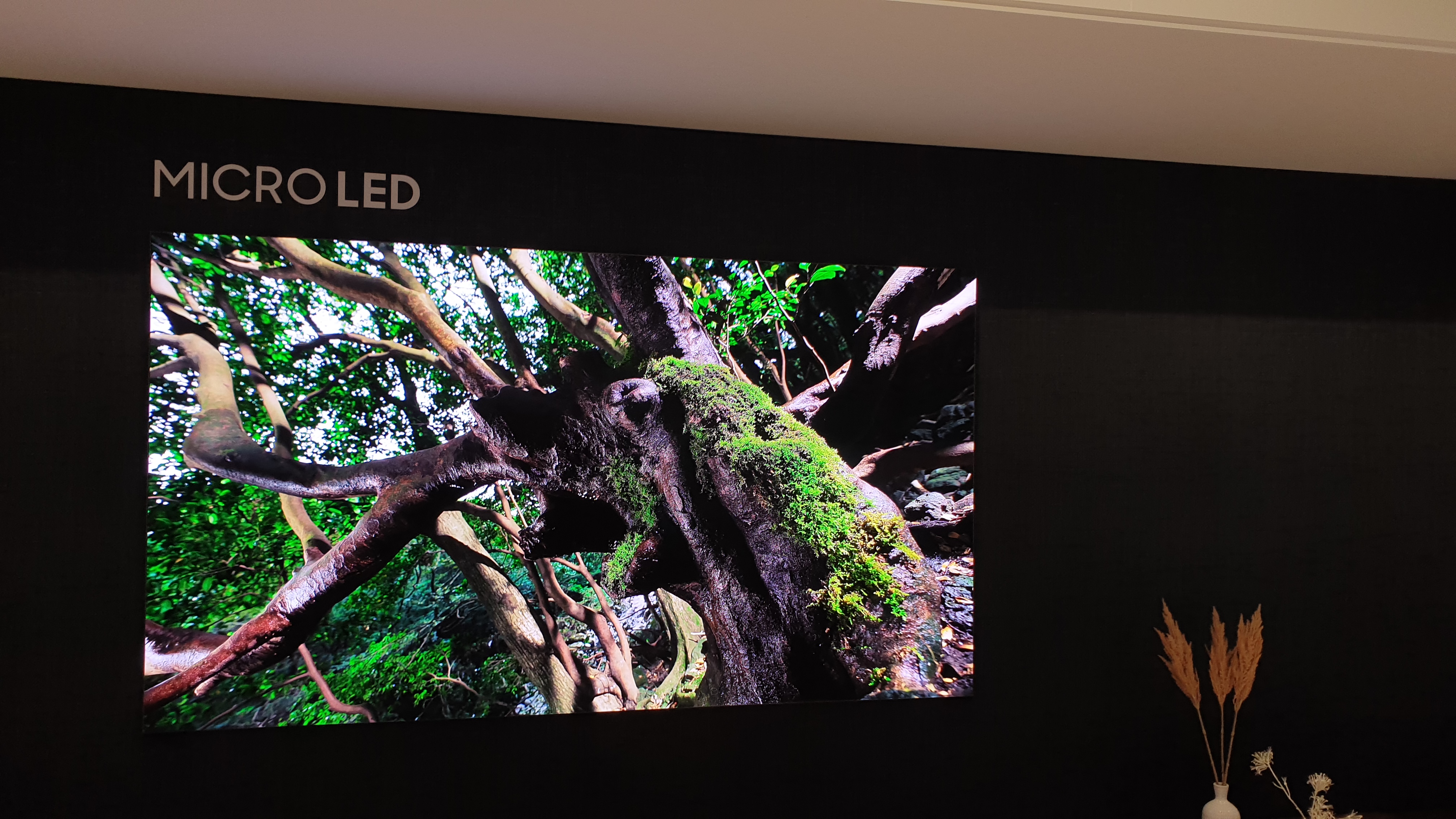
Samsung 110-inch Micro-LED TV mounted on black wall

Here's Samsung's 110-inch Micro-LED TV in the flesh. (Image credit: Future / Franziska Schaub)

According to The Elec, Samsung is not moving ahead with production of the 101-inch model it reportedly also planned to launch, at least not yet.

There's no word on the final price of this TV, but don't expect it be remotely affordable for us mere mortals, despite the improvements in production. The original given price for the 89-inch model was around $80,000, so even if Samsung has made further cost-saving strides, it's still going to cost around the same as a Mercedes CLS.

90-inch TVs are the new 75-inch TVs

All this talk of 89- to 100-inch TVs sounds a bit ambitious even before you get to the price of the micro-LED TV, but very large TVs seem to be the hot ticket right now. LG just launched its first 97-inch OLED TV right alongside Samsung launching a new 98-inch TV that's its brightest ever, for example.

Meanwhile, the best 75-inch TVs are growing more and more in popularity – a size that used to feel like it was only for millionaires is now something lots of people with an empty wall and home theater obsession are buying. We expect our guide to the best Black Friday 75-inch TV deals to be one of the biggest this year, because the TV companies have seen which way the wind is blowing too, and you can now find 75-inch TVs for comically low prices during sales events.

Which means that the people who want the biggest and best need something even bigger and better, right? So here we are in a world where 100-inch TVs are creeping in more, and we expect more in 2023.

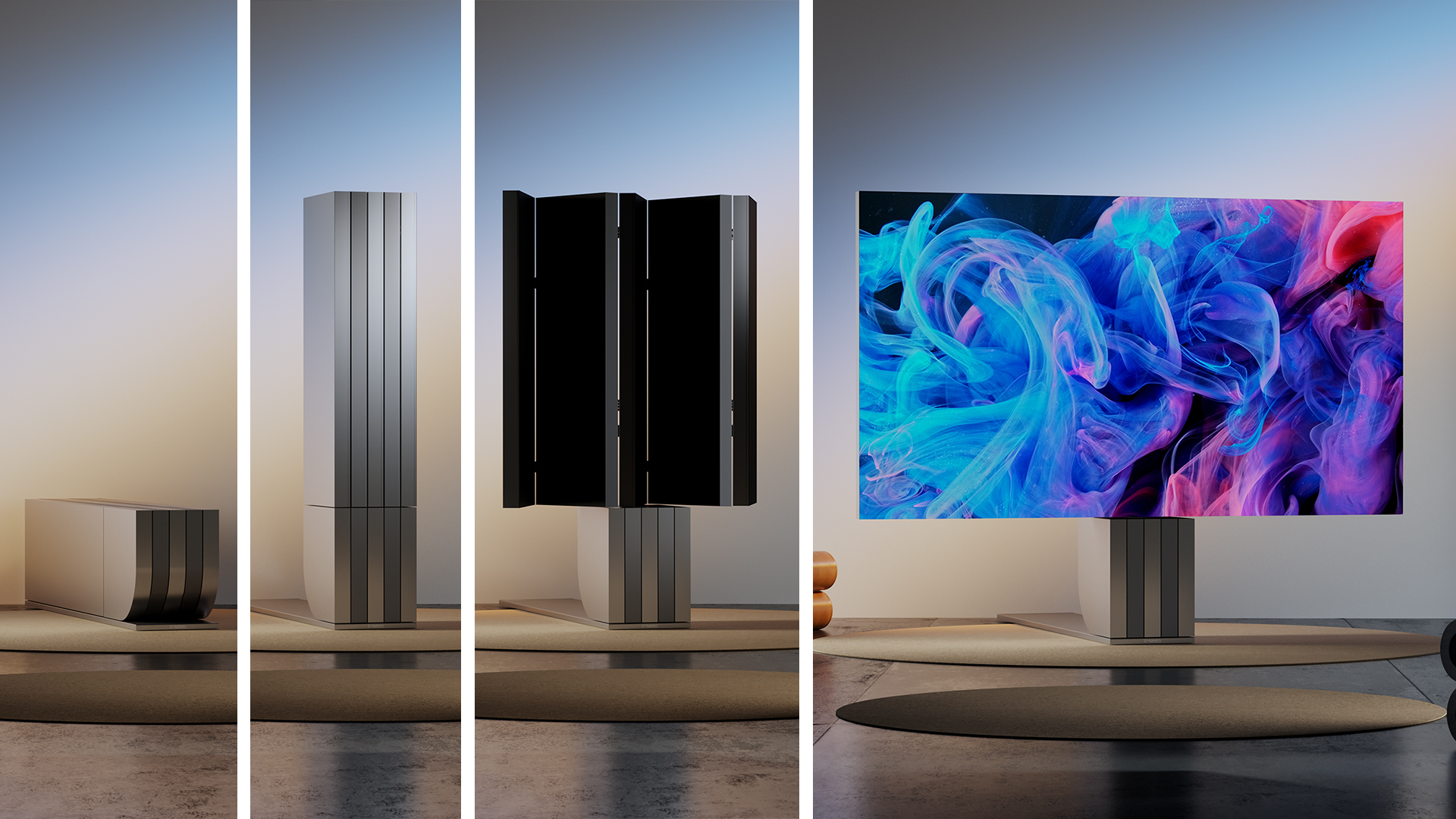
The real question is whether Samsung will ever create a micro-LED that's as cool as the folding C SEED N1 TV, based on the same tech…

C-SEED N1 TV image collage showing the set transforming from a metal cuboid to a TV

(Image credit: C-SEED)
https://ift.tt/wqtQ0lK

The Rings of Power didn't utilize Star Wars' Volume technology for one key reason

The Rings of Power's creative team considered using Star Wars' Volume technology – but decided not to for one major reason.

Chatting exclusively to TechRadar, VFX producer Ron Ames revealed that conversations were held about whether the Prime Video series should utilize the award-winning tech pioneered by Industrial Light and Magic (ILM).

For those unfamiliar with the tech, the Volume – otherwise known as StageCraft – is a virtual production set comprising a giant wall of LED screens. It allows filmmakers to shoot scenes with a blend of VFX and live-action, with the LED screen wall used as a CGI backdrop that actors and sets can be filmed in front of.

Essentially, StageCraft replaces the use of green screen technology, allowing actors to "interact" with the world around them, and get a sense of scale and size of the CGI environment that they're supposed to exist within. The wall screen can also be realigned in real time while a scene is being filmed, too.

Galadriel and Halbrand lead the Númenorean cavalry over a lush Southlands hill in The Rings of Power episode 6

The Rings of Power largely favored real world locations over stage sets. (Image credit: Prime Video)

The technology was initially designed for The Mandalorian, the first Star Wars TV show. It's proven to be so revolutionary, though, that StageCraft has been used on numerous Disney-owned properties, such as Marvel movie Thor: Love and Thunder. It's also been loaned out to other studios for certain projects, including DC superhero flick The Batman.

ILM were one of two main VFX studios – Weta FX being the other – that The Rings of Power's team hired to produce the high fantasy show's 9,500 VFX shots. Given the close working relationship between ILM and Amazon Studios' Lord of the Rings TV series, it isn't a stretch to suggest that ILM's LED wall-based Volume technology could have been used.

However, Ames confirmed that the Prime Video show's executive team decided against using the Volume and to primarily shoot on location instead. The reason? To ensure the series felt real and retained the natural aesthetic that Peter Jackson's Lord of the Rings film trilogy possessed.

"We used virtual production across the board," Ames explained. "But we didn't use LED walls because we chose to shoot on location. Using the Volume would have been complex for us. If you look at our imagery, it's wide and expansive. To try and contain that on an LED wall would have been impossible."

Three Numenorean ships sail into the sun drenched island kingdom of Numenor in The Rings of Power

The Rings of Power contains plenty of VFX shots – just none using the Volume. (Image credit: Prime Video)

Ames' reasoning is sound. StageCraft is a mightily impressive tool and one that's certainly made filming certain movies and TV shows a lot easier than before. After all, it allows actors to perform in environments that they can physically see – something that would have helped Sir Ian McKellen on the set of The Hobbit. Back in 2013, the legendary actor revealed he almost quit acting because he couldn't get to grips with the green screen technology used on that movie.

However, StageCraft clearly has its limitations. As Ames revealed, the screen wall boundaries are restrictive after a certain point and it doesn't possess the authenticity that a fully built set or real world location has. The team behind Andor, the latest Star Wars Disney Plus show, chose not to use the Volume for similar reasons, opting instead to film in actual locations or on detailed, fully realized sets that actors can live in and run around.

Amazon's Lord of the Rings, then, made the right call in not using StageCraft. It's a series already stuffed with VFX – Ames guesses that about 70% of the high fantasy show contains some element of technological innovation – so implementing the Volume would have made it feel even more visually sanitary than it sometimes is.

For more exclusive content on The Rings of Power, find out how that explosive episode 6 ending was brought to life. Alternatively, read up on whether the show's cast know who is really playing Sauron and the true identity of The Stranger.

https://ift.tt/ixcIT5b