Monday, 3 August 2020

Chinese internet users brand ByteDance CEO a ‘traitor’ as TikTok seeks US buyer

ByteDance is not backing down from its ambitions to become a global technology powerhouse, even as TikTok loses its largest market (India) and faces insurmountable challenges in the U.S. But some in China are blasting the Beijing-based company as too accommodating and yielding to U.S. demands.

ByteDance said it will “remain committed to our vision to become a globalized company” despite the flurry of challenges thrown at it, it said in a statement posted late Sunday.

Following months of efforts to sway U.S. regulators and the public, TikTok reluctantly arrived at two concessions: “We faced the real possibility of a forced sale of TikTok’s US business by CFIUS or an executive order banning on the TikTok app in the US,” ByteDance founder and CEO Zhang Yiming wrote to employees in a letter on Monday.

The TikTok saga is evolving on an hourly basis. As of writing, Microsoft has confirmed it’s in talks with U.S. officials to pursue a TikTok purchase. Trump previously said he would not support the purchase of the Chinese-owned app by an American company.

On the China end, Zhang told his staff that the company has “initiated preliminary discussions with a tech company to help clear the way for us to continue offering the TikTok app in the US.” The message corroborates reassurance from the app’s U.S. general manager Vanessa Pappas that TikTok is “not planning on going anywhere.”

Zhang is unabashed about his frustration in the letter: “We disagree with CFIUS’s conclusion because we have always been committed to user safety, platform neutrality, and transparency. However, we understand their decision in the current macro environment.”

Angry netizens

But ByteDance’s responses clearly have not won favor with some people in China. On Weibo, a popular microblogging platform in China, hundreds of anonymous users joined in under a post about Zhang’s letter, cursing him as a traitor of China, an American apologist and a coward, among many other labels.

“Zhang Yiming used to praise the US for allowing debate, unlike in China, where opinions are one-sided. Now he got a slap in the face, why doesn’t he go argue with the US?” chastised one of the most popular comments with more than 3,600 likes.

The commentator appears to be referring to some of Zhang’s Weibo posts from the early 2010s, which can be seen by some as liberal-leaning, putting the entrepreneur in the rank of “public intellectuals.” The term has in recent years been thought of as derogatory, as internet patriots see the group as ignorant and worshippers of Western values.

“The general view among Chinese social media users is that this is a tit-for-tat measure as part of the ongoing U.S.-China trade war. They also believe that these steps are being taken due to TikTok’s success and because it has now become a threat to U.S. platforms such as Facebook and Twitter,” said Rich Bishop, CEO of AppInChina, which helps international apps and games publish in China.

Zhang’s Weibo account is currently suspended, presumably to prevent armies of angry patriots from flooding his posts.

It’s hard to gauge how representative the online sentiment is of the Chinese public, or whether the discourse is orchestrated by government-paid commentators. Compared to the internet fury, though, Beijing appeared relatively resigned, with a Foreign Ministry spokesperson merely denying U.S. allegations against TikTok as fabricated “out of nothing” during a regular presser. (There’s no concrete evidence publicly presented by the U.S. government yet to support its claims that TikTok is a national security threat.)

After all, the Chinese government can’t do much to retaliate, given there are scant examples of American internet giants with a considerable business in China.

Sympathy from peers

Startups and investors in China are more sympathetic toward ByteDance. Many agree that if the Microsoft deal goes through, it could be the least bad outcome for TikTok.

“They are stuck between a rock and a hard place,” said William Bao Bean, general partner at Chinaccelerator, a cross-border accelerator backed by SOSV. “We are in a fast-changing regulatory environment. I think the consumers would probably want to continue using the service, and this is one potential way to make that happen. Obviously, I don’t think it’s what ByteDance really wants.”

AppInChina’s Bishop reminded us of Microsoft’s non-confrontational attitude toward Beijing. “I think it’s a good outcome for all sides. Microsoft of course benefits hugely from getting into social media. ByteDance gets a good payout, and Bytedance and the Chinese government are relatively friendly towards Microsoft.”

The tech community is well aware that TikTok is a rarity. Although the backlash will have a chilling effect on Chinese companies expanding to the U.S., and potentially other Western markets, there simply aren’t many internet companies going from China to the West in the first place.

“Most solutions that are built for China don’t solve problems that people have in the West,” observed Bao Bean.

Chinese games probably have the best shot in conquering the West, as WeChat parent Tencent, through aggressive acquisitions and numerous smash-hits, has demonstrated. Smaller developers resort to the strategy of “laying low” about their Chinese origin.

“We simply don’t take media interviews,” said the CEO of a U.S.-listed Chinese internet firm on condition of anonymity.

“It’s not about the chilling effect. The problem is there won’t be opportunities in the U.S., Canada, Australia or India anymore. The chance of succeeding in Europe is also becoming smaller, and the risks are increasing a lot,” a former executive overseeing an American giant’s Chinese business lamented, asking not to be named.

“From now on, Chinese companies going global can only look to Southeast Asia, Africa and South America.”


https://ift.tt/31hqRxn

Snapchat to take on TikTok with a new music-powered featuring rolling out this fall

Snapchat is taking aim at TikTok. The company announced today it will begin testing a new feature that lets Snapchat users set their Snaps to music, similar to TikTok’s app. The feature may allow Snapchat to capitalize on the fracturing of the TikTok audience, who have been exploring alternative apps as the Trump administration weighs a ban on Chinese tech companies over data privacy concerns.

Already, apps like Byte, Triller, Dubsmash, Likee, and others have climbed the app stores’ charts as TikTok users hedged their bets. Instagram also launched a music-powered feature called Reels to cater to the TikTok crowd.

In Snapchat’s case, users will be able to add music either pre or post capture from what the company promises will be a “robust” catalog of music. This is made possible by way of Snap’s deals with music industry partners, including Warner Music Group, Warner Chappell, Universal Music Publishing Group, NMPA publisher members, Merlin and others, who have licensed their music for use in Snapchat’s app.

When friends receive one of the new Snaps with music, they’ll be able to swipe up to view the album art, song title, and artist name. A “Play This Song” link will also be available. When clicked, it will open a webview to Linkfire that will allow users to listen to the full song — not a snippet — on their preferred music streaming platform, like Spotify, Apple Music or SoundCloud.

This aspect differentiates Snapchat’s implementation from TikTok, where clicking on a video clip’s “sound” link only takes users to a page featuring other clips that have used the same sound. But even though TikTok today lacks a feature that fully connects a user to the artist behind a popular music clip, much less the full song, TikTok’s power has continued to launch breakout hits as users hunted down their favorite TikTok artists across streaming services.

Snapchat says its music feature, however, will allow fans to form deeper connections with artists and music. It also spoke to its strength in being a tool for close friends which gives it more influence — largely because of how its younger user base values friend-to-friend recommendations. Today, Snapchat reaches 90% of all 13-24 year-olds in the U.S., more than Facebook, Instagram and Messenger combined, the company says. It also reaches 75% of 13-34 year-olds. And though TikTok has a large international base, Snapchat claims it reaches more U.S. users than Twitter and TikTok combined, based on publicly available data.

“We’re constantly building on our relationships within the music industry, and making sure the entire music ecosystem — artists, labels, songwriters, publishers and streaming service — are seeing value in our partnerships,” a company spokesperson said, with regard to the new feature.

Snapchat says it will roll out the new feature across English-language markets this fall.


https://ift.tt/3k4wzLr

Facebook launches commerce and connectivity-focused accelerator programs

Facebook launched two 12-week accelerator programs for startups on Monday as the social juggernaut looks for new ideas and solutions to expand its commerce and connectivity efforts.

Facebook’s Commerce Accelerator will select 60 startups from the EMEA and LATAM regions for the program, the company said. The startups that make the cut will explore building shopping solutions to drive commerce inside Facebook’s family of apps.

“Our goal is to make shopping seamless and empower anyone from an entrepreneur to the largest brand to use our apps to connect with customers,” wrote Michael Huang, Head of Startup Programs at Facebook, in a blog post.

The company said a recent global survey it conducted in partnership with the OECD and World Bank found that at least a third of small to medium-sized businesses on Facebook reported 25% or more of their sales being made digitally in the past month.

“With so many sales being made online, the importance of intuitive and positive e-commerce experiences for customers has become even greater,” the company said in a statement.

The other accelerator program, called Connectivity, will feature 30 startups from the LATAM and North America (Americas) regions. These startups will be tasked with developing affordable connectivity solutions that make internet access available in more places and to at least 100,000 additional people.

Facebook said through these accelerator programs it aims to provide local development opportunities for entrepreneurs. The company holds one or two similar accelerator programs each year in some markets. In total, the company has launched accelerator programs in 11 countries to date.

The coronavirus pandemic, which has forced Facebook to conduct the accelerator programs virtually this year, has “exposed the hard truth of the digital divide and the critical need for reliable, affordable internet connectivity,” wrote Huang.

Participating startups will gain access to cost-free training, 1:1 mentorship, and access to Facebook products, its expertise and access to a global network of startup peers and successful founders. But the company is not offering monetary benefits to startups —  something it has in some of its previous accelerator programs — at accelerators announced on Monday.

Startups interested in either of the accelerator programs can submit their application.

“At Facebook, we strongly believe that by connecting, training, and growing entrepreneurs and startups through our programs, we can empower people to solve relevant, meaningful problems. We aim to build products that billions of people can use and benefit from,” Huang wrote.

Facebook has long focused on connectivity efforts, but its interest in commerce is relatively new. In May, Facebook chief executive Mark Zuckerberg unveiled Facebook Shops to make it easier for companies to list their products on Facebook and Instagram.


https://ift.tt/3k7d1WL

Facebook fights order to globally block accounts linked to Brazilian election meddling

Facebook has branded a legal order to globally block a number of Brazilian accounts linked to the spread of political disinformation targeting the country’s 2018 election as “extreme”, claiming it poses a threat to freedom of expression outside the country.

The tech giant is simultaneously complying with the block order — beginning Saturday after it was fined by a Supreme Court judge for non-compliance — citing the risk of criminal liability for a local employee were it not to do so.

However it is appealing to the Supreme Court to try to overturn the order.

A spokesperson for the tech giant sent us this statement on the matter:

Facebook complied with the order of blocking these accounts in Brazil by restricting the ability for the target Pages and Profiles to be seen from IP locations in Brazil. People from IP locations in Brazil were not capable of seeing these Pages and Profiles even if the targets had changed their IP location. This new legal order is extreme, posing a threat to freedom of expression outside of Brazil’s jurisdiction and conflicting with laws and jurisdictions worldwide. Given the threat of criminal liability to a local employee, at this point we see no other alternative than complying with the decision by blocking the accounts globally, while we appeal to the Supreme Court.

On Friday a judge ordered Facebook to pay a 1.92 million reais (~$367k) fine for non compliance, per Reuters, which says the company had been facing further daily fines of 100,000 reais (~$19k) had it not applied a global block.

Before the fine was announced Facebook had said it would appeal the global block order, adding that while it respects the laws of countries where it operates “Brazilian law recognizes the limits of its jurisdiction”.

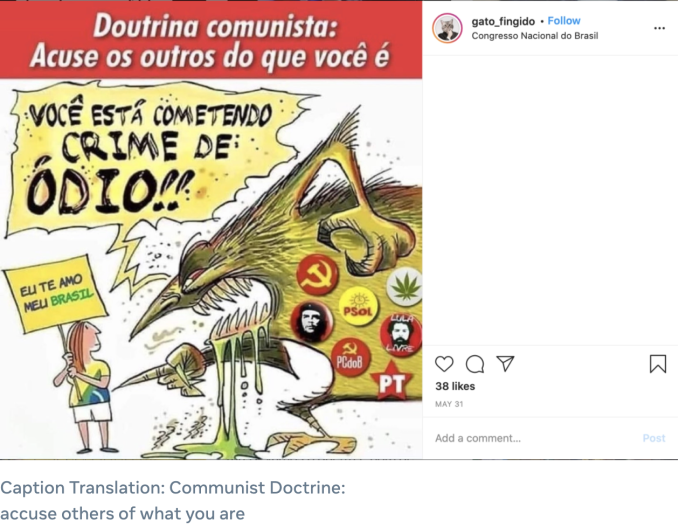
Reuters reports that the accounts in question were controlled by supporters of the Brazilian president, Jair Bolsonaro, and had been implicated in the spread of political disinformation during the country’s 2018 election with the aim of boosting support for the right wing populist.

Last month the news agency reported Facebook had suspended a network of social media accounts used to spread divisive political messages online which the company had linked to employees of Bolsonaro and two of his sons.

In a blog post at the time, Facebook’s head of security policy, Nathaniel Gleicher, wrote: “Although the people behind this activity attempted to conceal their identities and coordination, our investigation found links to individuals associated with the Social Liberal Party and some of the employees of the offices of Anderson Moraes, Alana Passos, Eduardo Bolsonaro, Flavio Bolsonaro and Jair Bolsonaro.”

In all Facebook said it removed 33 Facebook accounts, 14 Pages, 1 Group and 37 Instagram accounts that it identified as involved in the “coordinated inauthentic behavior”.

It also disclosed that around 883,000 accounts followed one or more of the offending Pages; while the Group had around 350 accounts signed up; and 918,000 people followed one or more of the Instagram accounts.

The political disops effort had spent around $1,500 on Facebook ads, paid for in Brazilian reais, per its account of the investigation.

Facebook said it had identified a network of “clusters” of “connected activity”, with those involved using duplicate and fake accounts to “evade enforcement, create fictitious personas posing as reporters, post content, and manage Pages masquerading as news outlets”.

An example of removed content that was being spread by the disops network identified by Facebook (Image credit: Facebook)

The network posted about “local news and events including domestic politics and elections, political memes, criticism of the political opposition, media organizations and journalists”; and, more recently, about the coronavirus pandemic, it added.

In May a judge in Brazil had ordered Facebook to a block a number of accounts belonging to Bolsonaro supporters who had been implicated in the election meddling. But Facebook only applied the block in Brazil — hence the court order for a global block.

While the tech giant was willing to remove access to the inauthentic content locally, after it had identified a laundry list of policy contraventions, it’s taking a ‘speech’ stance over purging the fake content and associated accounts internationally — arguing such an order risks overreach that could damage freedom of expression online.

The unstated implication is authoritarian states or less progressive regimes could seek to use similar orders to force platforms to apply national laws which prohibit content that’s legal and freely available elsewhere to force it to be taken down in another jurisdiction.

That said, it’s not entirely clear in this specific case why Facebook would not simply bring down its own banhammer on accounts that it has found to have so flagrantly violated its own policies on coordinated authentic behavior. But the company has at times treated political ‘speech’ as somehow exempt from its usual content standards — leading to operating policies that tie themselves in contradictory nots.

Its blog post further notes that some of the content posted by the Brazilian election interference operation had previously been taken down for violating its Community Standards, including hate speech.

The case doesn’t just affect Facebook. In May, Twitter was also ordered to block a number of accounts linked to the probe into political disops. It’s not clear what action Twitter is taking.

We’ve reached out to the company for comment.


https://ift.tt/30lNAJ6

Saturday, 1 August 2020

TikTok says it’s “not planning on going anywhere” in response to pending U.S. ban

TikTok’s U.S. General Manager Vanessa Pappas has posted a video message to the platform that appears to be a response to reports from Friday that President Trump is working on an effective “ban” of the app in the U.S., a plan he shared with reporters from the White House pool on board Air Force One. Whether or not he’s even able to do this remains an open question, but in the meantime TikTok seems keen to reassure U.S. users it doesn’t intend to change its operational plans in response to this vague, but potentially existential threat.

The message from Pappas was pushed out to all U.S.-based users on TikTok as a notification, and appears on their discover page, making it clear they want this seen by the entire community. It starts by thanking users on the platform, and highlights some of its U.S.-based contributions, namely the jobs it has created to date, and committed to creating in future, and the fund it has set up to support creators in the U.S. and globally.

Pappas ends by asserting that TikTok is “here for the long run,” and calling for community support to “stand for TikTok.”

Trump’s assertion that he plans to sign an order as early as Saturday to bar U.S. access to the app followed reports that Microsoft is in talks with the company’s China-based owner ByteDance to potentially acquire its U.S. business. Trump appeared to discount any support for that possibility in his comments to the White House press pool, but a new report from Saturday morning said that Microsoft is indeed in talks to acquire a stake in TikTok and take over stewardship of its U.S. user’s data, as part of a potential deal to stave off any ban.

Again, it’s not clear what executive powers would actually allow Trump to put in place a U.S.-wide ban of the application, but it looks like ByteDance is working with parties in the U.S. on a deal that assumes he’d be able to do so unless the Chinese company divests entirely its U.S.-based TikTok operations to an American owner.


https://ift.tt/3hSlACM

What brands need to do if they want to break up with Facebook

With more than 90 major advertisers and counting announcing plans to dump Facebook, a significant question lingers: Where will brands go next for their digital marketing needs?

The case for the breakup is clear: Brands want to distance themselves from third-party business practices that do not align with their values. Specifically, they are disenchanted by what even some members of Congress are calling Facebook’s “lackadaisical” approach to enforcing community standards, allowing an epidemic of paid political misinformation and hate speech to persist on the user-driven platform.

However, with Google, Facebook and Amazon representing just under 70% of global digital ad revenue, a clean break from the tech giants is easier said than done. Advertisers, like anyone facing a breakup, must look within. After all, they don’t want to make the same mistakes and they cannot just throw newly freed up advertising dollars at a new social network ad platform, where similar conflicts could easily follow.

With introspection, advertisers will see that this is more than just a war on disinformation and hate speech. A data war is brewing, pressuring businesses to diversify data sources. As brands compete to understand the needs and preferences of today’s consumers, consumers are concurrently responding with more guarded protection of their online data.

To win this war, brands must reclaim data autonomy and infuse their digital media strategy with more diversified data. But they cannot do it alone and they cannot do it within the current system.

Time to brandish holistic data

Whether Facebook adjusts its community standards to appease dismayed advertisers has yet to be seen. But in the interim, as advertisers walk out the door, it’s worth noting that Facebook’s reliance on online data may soon be obsolete anyway.

One of the key differentiators for Facebook’s ad platform has been its ability to help level the playing field for smaller brands by cost-effectively captivating the right audiences. But the platform primarily draws insights from audiences’ behaviors online. The next wave of data-based marketing must employ tools that blend first-party data and qualified third-party data to offer a holistic view of customer behaviors, both online and offline.

Offline data sets, which include location intelligence, interactions, purchase history, contact information and demographics are lynchpins in the next digital media wave because they allow brands to develop a more human view of consumer data and create meaningful marketing moments. For example, location intelligence, an extremely potent tool that is currently helping brands pivot during COVID-19 disruptions and is even protecting public health, can drive personalized, alluring marketing campaigns with massive ROI opportunities.

The leading integrated data providers are managing extremely rich datasets, which increase in value daily as consistent tracking yields higher quality data. Such powerful and enriched data stacks offers brands visitor insights based on a specific location after an ad is interacted with on any device — requiring no guesswork for the marketing team. Brands are able to pinpoint exactly which messages resonate with which segments of their audience at which time. This precision ultimately helps them craft the right message for the target consumer — and deliver it at the exact right moment.

Marching orders for combat

Brands want to cut Facebook loose but where do they go next? How do they achieve data autonomy and make omnichannel strides in digital marketing? If the boycott movement is to succeed, revolutionary changes to the digital marketplace are needed.

A newly imagined system must be organized outside the proprietary grasp of any one single tech conglomerate. Otherwise, advertisers will lack ownership of the data they need to reach new audiences. Or they’ll once again get mixed up with similar paid political disinformation and hate speech across user-generated platforms, sending them straight back into the arms of Facebook.

Rather than rely on a single centralized social media platform, transparent media partners and publishers must come together on a shared central system that takes an omnichannel approach to building lookalike (LAL) audiences. A LAL puts advertisers in front of new audiences by finding users that, while they may be unfamiliar with their brand, are very similar to the buyer personas of their current customers. The LAL for each advertiser would be constantly tested and refined to keep pace with the rapidly changing marketplace.

Facebook currently operates on a LAL model but it is almost exclusively generated by online data from their users. The next step is expanding on this model and infusing offline and third-party data with a company’s first-party data, putting them in front of a LAL across a range of media partners and platforms. This will help build a core conversion audience, while constantly scaling new LALs for each brand.

Such a system would require collaboration, enlisting many players in a co-op style undertaking. For example, to get it off the ground, it would be helpful if about 20 of the large brands boycotting Facebook invest some of their newly freed advertising dollars to establish the data and publisher sharing co-op network.

Once the advertiser framework is set, the co-op would need to identify media outlet partners such as news websites, blogs, apps, podcasts and social media outlets. The co-op would negotiate a performance-based publisher relationship for every player, effectively increasing content monetization for publishers’ content channels.

Reinventing the digital media landscape

This would be a transformational movement, galvanizing brands with data autonomy and increasing customer engagement across an entire network of media platforms — not just one platform. Each advertiser’s first-party data, which they’ve already given to Facebook, would be analyzed to isolate data overlaps within the co-op. This would essentially lay the foundation for building a core conversation audience, helping each advertiser tap new LALs.

Brands advertising with the co-op would gain access to more enriched, robust insights on consumers than Facebook could ever offer, leading to a higher return on investment for the $336 billion spend on digital advertising annually.

Most importantly, it would help brands future-proof their digital marketing efforts and grant them greater freedom in choosing where their advertising dollars are being spent.

That is how the war is won.


https://ift.tt/2Eye3L4

Friday, 31 July 2020

Twitter survey reveals the subscription options it’s eyeing, including an ‘Undo Send’ button

Earlier this month, Twitter told investors it’s considering a subscription model as a means of generating additional revenue to support its business. Now we know what sort of value-add features Twitter may be eyeing. In a new survey, the company asks users to evaluate paid features like “undo send” (an alternative to an edit button), as well as other ideas like custom colors, the ability to publish longer and more high-def videos, support for profile badges, auto responses, additional “social listening” analytics, and the ability to run brand surveys about ads.

The survey asks users to select the options they felt were most or least important to them. 

Details of the survey were first published to none other than Twitter itself by Twitter user @WFBrother. The findings were then amplified by eagle-eyed social media consultant, Matt Navarra, who had also seen the survey.


A Twitter spokesperson confirmed the questions had come from a survey the company was running to evaluate options for a membership model, as the survey describes.

The company declined to offer any further comment, but noted its Q2 shareholder letter had detailed its plans in this area:

“We are also in the early stages of exploring additional potential revenue product opportunities to compliment our advertising business,” the letter had said. “These may include subscriptions and other approaches, and although our exploration is very early and we do not expect any revenue attributable to these opportunities in 2020, you may see tests or hear us talk more about them as our work progresses,” it noted.

Specifically, the survey asked users about the following options:

  • Undo Send: A 30 seconds window for you to recall/withdraw a Tweet before anyone can see it. This has been something Twitter has suggested in the past could be a viable alternative to an “Edit” button — something users have demanded for years. Instead of allowing unlimited edits to tweets, and the significant engineering investment that would entail — users could instead quickly fix a typo they spotted shortly after posting.
  • Custom Colors: In addition to “Night Mode,” you could change the fonts and theme color of Twitter on your phone and computer. Background color, links, mentions, hashtags, and icons would appear in whatever color you choose.
  • Video Publishing: You could publish videos up to 5x longer than current default, which a much higher maximum resolution (8192×8192)
  • Badges: You get a badge(s) on your profile that links to businesses you own or work for (Example: A journalist can have a badge showing the magazines they write for.)
  • Auto responses: Able to write and set a menu of auto responses to use in replies. This would likely be more useful to brands who wanted to redirect customer inquiries to official channels.
  • Social listening: You can see conversation around your account on Twitter, including total volume, the people and businesses who are talking most often, and what they are saying. This, again, would largely appeal to brands.
  • Brand Surveys: You could be able to survey people about the ads you run to better understand if you ad was memorable and if people are likely to buy the products or services featured. Twitter today already runs similar ads, so this feature would be relatively easy for it to implement.

The survey does not represent features Twitter will definitely roll out as part of any future membership model, of course. It’s only the first step to gathering consumer feedback about what people believe is worth paying for.

Not on the survey? A real “edit” button, of course. That one just may never happen!


https://ift.tt/2Ew4QD0