Monday, 3 September 2018

Toshiba tease 8K TV on a budget

TV used to be the entertainment center of the home, but as mainstream technology has evolved to include smartphones, streaming, and smart speakers, the television has become less essential for many consumers. 

This is something Toshiba hopes to rectify with its latest range of high-spec TVs, including its first ever 8K TV concept model. 

Although it is not predicted to go to mass production anytime soon, we got a first look at the trailblazing TV at Berlin's IFA conference.

Streamlined design

Toshiba's aim is to bring the 8K TV to the mainstream market, by developing an 8K TV that is more accessible for a wider variety of users and homes. 

Many 8K TVs are in excess of 80", so Toshiba's 65" model is more suited to a range of living spaces, with the narrower width offering a higher pixel density for even clearer viewing. 

Like the majority of Toshiba’s latest range, its 8K model has a sleek and unobtrusive design, with super thin edges for unobstructed viewing, and a discreet silver stand that will blend in to any style of decor.

We saw the TV mounted to the wall, but it can be placed on a TV stand - however, even at a lower than usual width of 65", it would take up a huge amount of space in most people's living areas, plus it definitely looks more impressive when wall-mounted. 

Stunning colour

Toshiba’s 8K model is an HDR TV, so colors are extremely vivid, the contrast is sharp and precise, and the picture clarity is astounding. As the screen is smaller than most 8K models debuted at IFA, the pixel density is so rich that it’s impossible to see the pixel structure with the naked eye. The result? It looks absolutely stunning.

Although there is very little 8K content available at present, the TV comes with an 8K upscaler so you can elevate your lower-res content. Also, with an HDMI 2.1 input built-in, you will be able to watch 8K content as soon it becomes available.

When we saw the TV Toshiba were only displaying still or slightly animated images, so it was hard to tell how moving footage (in sports or film for example) would measure up to other 8K models debuted at the conference. 

However, even the still images were breathtakingly precise, with rich, vibrant color thanks to its wide color gamut, which can handle around 1024 shades for each color, as well as Dolby Vision for accurate imaging. 

It’s always difficult to review televisions without ‘living’ with them for awhile - after all, seeing silent TVs at a tech conference isn’t exactly the most natural way to watch TV. 

That being said, we were blown away by the image quality, and would be surprised if a similar level of care hadn’t been put into the sound. 

Don't hold your breath...

If you’re itching to get your hands on this TV right away, you’re going to be disappointed - as it is only a concept model, it’s unlikely to go to mass production anytime in the near future. 

Pricing is also yet to be confirmed, however Toshiba has suggested that it will be one of the more affordable models available.

Final thoughts

Toshiba’s first foray into the world of 8K TVs appears to have resulted in a stunning product, but of course it’s difficult to say exactly how well it will perform until there is more 8K content available. 

However, we were able to see just how crisp the image quality was, and were blown away by the color precision and lack of any discernible pixels. 

We also liked the subtle design of the monitor, which is likely part of Toshiba’s plan to make the 8K TV more accessible for a wide variety of homes and customers. That being said, the true measure of accessibility will be the price, with some of the other recently announced 8K TVs expected to cost well into the thousands - whether Toshiba can genuinely make this product affordable remains to be seen. 

  • IFA 2018 is Europe's biggest tech show. The TechRadar team is in Berlin to bring you all the breaking news and hands-on first impressions of new phones, watches and other tech as they're announced.
https://ift.tt/2wCMHMb

Here are the speakers so far for TechCrunch Startup Battlefield MENA 2018

We’re excited to head to Beirut, Lebanon, on October 3rd for TechCrunch Startup Battlefield MENA 2018. Yes, we’re bringing our premier startup pitch competition to the Middle East / North Africa, and as well as launching 15 of the hottest startups in MENA on stage for the first time, we’ll also be joined by some leading lights of the scene.

Tickets to this event — our first in this part of the world — cost $29 (including VAT), and you can buy your tickets right here.

Startup Battlefield consists of three preliminary rounds with 15 teams — five startups per round — who have only six minutes to pitch and present a live demo to a panel of expert technologists and VC investors. After each pitch, the judges have six minutes to grill the team with tough questions. This is all after the free pitch-coaching they receive from TechCrunch editors.

One startup will emerge the winner of TechCrunch Startup Battlefield MENA 2018 — and receive a US$25,000 no-equity cash prize and win a trip for two to compete in the Startup Battlefield at TechCrunch Disrupt in 2019 (assuming the company still qualifies to compete at the time).

Joining us on stage will be the following speakers, drawn from many of the key founders and investors in the region. Here are the speakers so far for TechCrunch Startup Battlefield MENA 2018 and there are more to come!


Kenza Lahlou
Managing Partner
Outlierz

Kenza is the co-founder and Managing Partner of Outlierz Ventures, is a seed investment fund, based out of Morocco, providing smart capital to African tech enabled startups. Kenza started the fund after 4 years experience building the Moroccan startup scene through StartupYourLife, one of the key ecosystem players. She co-founded it after gaining experience in San Francisco working closely with startups and accelerators in emerging markets. Prior to that, she worked in PE, management consulting and tech industry.


Mai Medhat
Eventus

Mai Medhat is the CEO and co-founder of Eventtus; an events engagement platform and the leading event app provider in the Middle East. Mai is an Egyptian tech entrepreneur holds a Computer Engineering degree from Ain Shams University. She co-founded Eventtus in 2012 with a mission to mobilize events after a personal experience at some events that used to be managed manually. The company successfully served 10,000 events since then and is growing into 35+ cities. Mai was named “Entrepreneur of the year” by Arabian Business in 2016 and she has been recognized by the Global Entrepreneurship Summit 2016 as one of the most promising MENA entrepreneurs.


Ameer Sheerif
Wuzzuf

Ameer Sherif is CEO and Co-founder of WUZZUF – Egypt’s #1 Online Recruitment Platform. Having co-founded WUZZUF 5 years ago, Ameer managed to bootstrap for 3 years during the tough revolution years until reaching profitability and then successfully fundraising from top angel investors in Egypt as well as top VCs in Silicon Valley – making WUZZUF the 1st startup from Egypt to join the [500 Startups] accelerator program in San Francisco. Now, WUZZUF helps 150,000+ people looking for jobs each month and serves 4,000+ companies. A total of 40,000+ Egyptians got hired directly through the platform so far.


Priscilla Elora Sharuk
Co-Founder & COO
Myki

Priscilla Elora Sharuk is the Co-Founder & COO of Myki, named one of the Best Free Password Managers of 2018 by PCMag. Priscilla has appeared in Forbes, The Wall Street Journal, and CSO. Forbes has also recognised her as one of the “Top 7 Female Entrepreneurs in MENA in 2017”. Priscilla believes in sharing what she continues to learn on her entrepreneurial journey in hopes of inspiring others.


Paul Chucrallah
Managing Director
BeryTech Fund

Paul Chucrallah is managing director at BeryTech Fund II. Prior to this, he was the business & strategy senor advisor at BeryTech. He was previously executive director at BeryTech Technology and Health.

Henri Asseily
Managing Partner
Leap Ventures

Henri Asseily is a managing partner at Leap Ventures, a late-stage venture capital firm based in Beirut and Paris. For the previous 20 years he was a serial entrepreneur focused on internet-related businesses, and he has particular expertise in algorithmics and computer science. He is the founder of Bizrate.com / Shopzilla, acting as CTO until its sale in 2005 for $569 million. He was designing flat models before they were called NoSQL, and led the creation of the first product-centric online search engine.


Amir Barsoum
CEO & Founder
Vezeeta.com

Amir Barsoum is the CEO & Founder of Vezeeta.com, a leading digital healthcare platform in MENA that connects patients with healthcare providers and health services. Prior to Vezeeta, Amir was a Management Consultant at McKinsey & Company advising Healthcare and FMCGs across public and private sectors in Europe and MENA. He also led the Strategy Team of AstraZeneca in MENA. Amir introduced Vezeeta in 2012 empowering millions of patients through data and the ability to better access healthcare in the region.


Rami Al Qawasmi
CEO
Mawdoo3

Founder and CEO of Mawdoo3.com, holds a bachelor’s degree in Economics from University of Sussex in England, with a passion in business,


Omar Gabr
Instabug

Omar started Instabug in 2012 right after graduating from college. He studied Computer Science at the Cairo University in Egypt. Instabug is an Egyptian based company that empowers mobile-first companies to iterate faster and enhance their app quality. Instabug is currently serving over one billion users worldwide and being used by the top apps in world including eBay, Lyft, Electronic Arts and thousands more.


Hussam Hammo
CEO & Founder
Tamatem Inc.

Hussam Hammo is founder & CEO of Tamatem Inc., the leading mobile games publisher in the Arabic speaking market. He is a serial-entrepreneur who founded Faye3.com, the first Arabic social network that was acquired by Maktoob.com which was later acquired by Yahoo. Hussam then co-founded Wizards Productions in 2009 a gaming studio and finally Tamatem, which currently has 30 employees in its HQ in Amman, Jordan where they have published 40 games with over 50M downloads.

https://ift.tt/2wxeQFp

Sunday, 2 September 2018

When battery life saves human life

Few would equate human life with battery life, but for many migrants escaping war or famine, a single percentage point of battery can mean getting the right information at the right time – or not surviving at all.

Smartphones today have become an integral part of a forced migrant’s journey. From navigating mountains in Central Asia using Google Maps to staying connected with family back home via WhatsApp, smartphones have transformed the migrant experience – though not always for the better.

No electron spared

In Eastern Europe, many migrants pushed back from Hungary stay along the border on the Serbian side in abandoned buildings. Volunteers visit these sites to bring supplies, including repurposed car batteries that migrants use to charge their phones.

At one abandoned building less than a mile from the Hungarian border, migrants huddle around one car battery to charge their phones, and they all agree about the importance of battery life to them. Many asked for a power bank to enable them to charge their phone when outlets are not available. Between each other, they constantly compare notes on what apps use up the most battery power, and remind each other to close apps when not in use.

Nashid, a migrant from Pakistan taking shelter in this building, says one of his primary needs at this remote outpost is for a way to charge his phone. With no regular access to electricity, he depends on the visits of volunteers to be able to charge his battery, concocting all sorts of ways to keep it alive until their next visit. Some of his strategies include making sure his phone is turned off when he sleeps at night or if he naps during the day, as well as using the lowest brightness level possible. He swears that taking out a dead battery and shaking it repeatedly provides him with a few extra minutes of phone use.

For many migrants traversing Eastern Europe to get to Western Europe, the Hungarian-Serbian border presents the final frontier. Once in Hungary, migrants will have entered the Schengen Area, the 26 EU-member zone with no border controls, making their destination countries in Western Europe significantly easier to reach. Increased security though has made this border crossing significantly harder – with many migrants being beaten and pushed back into Serbia dozens of times before they eventually make it across.

Nashid has been trying to cross into Hungary from Serbia for the past eight months. He left his family, including a wife and two kids, back in Pakistan before setting out to Europe. He says he uses WhatsApp to keep in touch with them and to stay connected to his cousin in Paris – his ultimate destination. He admits, battery constraints aside, that his phone also provides him with a reprieve from long hours spent idly waiting every day. He tries to sneak a song or two, or watch a couple of Urdu-language videos on YouTube.

One journey, a million apps

Over the last few years, Serbia has taken on the role of a major transit point for migrants trying to make it to Western Europe. The Refugee Aid Miksalište Center in the Serbian capital Belgrade, a drop-in center open 24 hours a day, is staffed by NGOs that provide services to migrants in transit. As soon as you enter the Center, you again see migrants gathered around extension cords, charging their phones and using the Center’s free Wi-Fi to access their social media and Skype with friends and family back home.
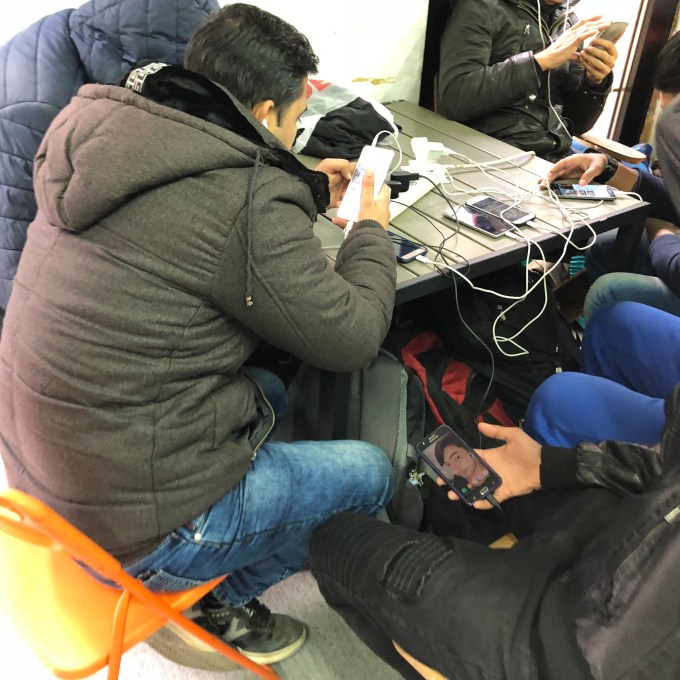
Migrants in Serbia huddle around a power strip to charge their smartphones (Photo by Ziad Reslan)

The same scene seems to repeat wherever migrants congregate. The nearly 70 million forced migrants across the world today have had to travel thousands of miles to get to a place of refuge. More than half of these migrants come from just three countries: Syria, Afghanistan, and South Sudan. Syrians, the single largest forcibly displaced population, have to traverse on average more than 1,400 miles just to get to Serbia’s border with Hungary on their long trek from Aleppo to Western Europe.

From getting directions, to learning languages, to simply accessing entertainment, smartphones have become vital for migrants on these grueling journeys that can last for months – if at the very least to get some emotional support by talking to loved ones they leave behind.

At the height of the European refugee crisis in the summer of 2015, when nearly a million Syrian refugees crossed into Europe to escape a brutal civil war, Facebook and WhatsApp chat groups sprung up to let migrants know of real-time developments on the road, which smugglers to trust, and what rates to negotiate. Dropped GPS pins and Google Maps turn directions into practical routes migrants can take. In some cases, migrants on sinking boats in the Mediterranean have helped coast guards find them by sending GPS signals from their smartphones.

Migrants download German, French, English, and other language learning apps on their phones to aid them in acculturating to their eventual destination while they’re still on the move. They use Google Translate to understand road signs in Bulgarian, Serbian, and Hungarian. And with migrant journeys breaking up families, smartphones have become migrants’ only way to stay connected.

In recognition of the importance of connectivity to forcibly-displaced migrants, the United Nations Refugee Agency (UNHCR) – launched “Connectivity for Refugees” in mid-2016. The initiative advocates for migrants’ right to connectivity; enables access through negotiated data rates for refugees, subsidized device prices, and internet access centers; and provides training to ensure migrants are able to fully take advantage of their smartphones. Two years in, the UNHCR plans to increase the initiative’s staffing and roll out connectivity programs beyond the current pilot countries of Jordan, Greece, Chad, Malawi, Tanzania, and Uganda.

Startups, for their part, have also been ramping up efforts to help migrants. Two Columbia architecture students, Anna Stork and Andrea Sreshta, cofounded LuminAid. A startup that makes the PackLite Max 2-in-1 Phone Charger, a solar-powered phone charger and light source that the cofounders have given away to displaced migrants. With the UNHCR estimating that up to a third of a forced migrant’s income is spent on connectivity, Phone Credit for Refugees has taken on providing migrants with free data access. Others, like GeeCycle, have instead focused on collecting used smartphones from around the world and distributing them to refugees fleeing conflict.

The challenge of misinformation

NGOs like Save the Children Serbia operate out of the Refugee Aid Miksalište, a drop in center with free WIFi and available plugs. (Photo by Ziad Reslan)

For all of their benefits though, smartphones have not always improved the journeys of forced migrants. The reliance on anonymous sources on social media to navigate routes has left migrants vulnerable to smugglers and traffickers looking to take advantage of their misfortune. Even information obtained from relatives can turn out to be erroneous – with heart-wrenching consequences.

Jelena Besedic, an Advocacy Manager for Save the Children Serbia, says that the spread of misinformation has been part of the reason for the rise of unaccompanied children traversing the Balkans from Afghanistan. Parents of kids as young as eight now stuck in Serbia were falsely told that, if their kids arrive safely in Western Europe, they’re entitled to bring their parents.

Misinformation of this sort about the ease of the asylum process can lead migrants to take on increasingly dangerous journeys, only to be disappointed with the reality once they reach their destination countries. This misinformation has led organizations, like the International Organization for Migration, to start information campaigns at source countries to better educate would be migrants about the dangers of setting out west. In addition, increasingly nationalist governments, like Hungary and Italy, have started campaigns targeting the smartphones of migrants with text messages and online ads to dissuade them from coming to their countries in the first place.

Familial pressure on migrants may have always been a reality, but access to smartphones has made that pressure incessant and instantaneous. Stuck at the border between Serbia and Hungary, Nashid says he would never have made the trek if he knew what he would have to face on his more than 4,000-mile journey from Pakistan to France. But while he was still in Pakistan, he had received messages non-stop from his cousin in Paris telling him how easy it was for him to get there and how plentiful jobs are in France. Once Nashid left Pakistan, messages from his wife and two kids constantly asking whether he’d arrived in Paris have made the idea of going back home impossible.

Nashid ends our conversation by asking me to confirm a rumor he’s heard on WhatsApp. Is it true, he asks, that there are now personal battery banks that one can charge like a phone that extend a smartphone’s battery life by up to 100 hours? A charger like that, he stresses, would make a world of a difference to him out here miles away from the nearest plug.

https://ift.tt/2LQ9mdF

Twitter's latest tests cover online status and threaded replies

Twitter is testing out a couple of new features that may or may not make their way out to everyone on the social network: online status indicators, so you can see who's online, and threaded replies to tweets, to make them easier to read on screen.

Announced by both director of product management Sara Haider and CEO Jack Dorsey, the new features are very much still in the prototype phase – Twitter is asking for feedback on how they work, and they might well change form before they're finished (if they ever get introduced at all).

According to Haider, the online status indicators are a way "to signal specifically that you're online and looking for conversation" as opposed to, say, being in a meeting or asleep. Presumably, you'll be able to turn this off if you don't like it.

Testing, testing, 1-2-3

Twitter is of course testing new features all the time, and they don't all make it to the platform. Most recently, engineers have been playing around with suggesting accounts that you might want to unfollow, which seems a bit anti-social.

There's also the ongoing battle to fight trolls and abuse that Twitter management have to deal with, in the middle of rolling out new features. Most recently, Twitter had an account purge to remove about a million accounts a day run by bots and shady users. It doesn't sound like the great Twitter clean up of 2018 is finished yet, either.

With the online status and threaded reply options only available to a few users right now, it's unlikely that you'll see them in your own timeline at the moment – we'll keep you posted on whether or not these features are going to be properly added to Twitter.

https://ift.tt/2PsaBSs

Saturday, 1 September 2018

It’s time for Facebook and Twitter to coordinate efforts on hate speech

Since the election of Donald Trump in 2016, there has been burgeoning awareness of the hate speech on social media platforms like Facebook and Twitter. While activists have pressured these companies to improve their content moderation, few groups (outside of the German government) have outright sued the platforms for their actions.

That’s because of a legal distinction between media publications and media platforms that has made solving hate speech online a vexing problem.

Take, for instance, an op-ed published in the New York Times calling for the slaughter of an entire minority group.  The Times would likely be sued for publishing hate speech, and the plaintiffs may well be victorious in their case. Yet, if that op-ed were published in a Facebook post, a suit against Facebook would likely fail.

The reason for this disparity? Section 230 of the Communications Decency Act (CDA), which provides platforms like Facebook with a broad shield from liability when a lawsuit turns on what its users post or share. The latest uproar against Alex Jones and Infowars has led many to call for the repeal of section 230 – but that may lead to government getting into the business of regulating speech online. Instead, platforms should step up to the plate and coordinate their policies so that hate speech will be considered hate speech regardless of whether Jones uses Facebook, Twitter or YouTube to propagate his hate. 

A primer on section 230 

Section 230 is considered a bedrock of freedom of speech on the internet. Passed in the mid-1990s, it is credited with freeing platforms like Facebook, Twitter, and YouTube from the risk of being sued for content their users upload, and therefore powering the exponential growth of these companies. If it weren’t for section 230, today’s social media giants would have long been bogged down with suits based on what their users post, with the resulting necessary pre-vetting of posts likely crippling these companies altogether. 

Instead, in the more than twenty years since its enactment, courts have consistently found section 230 to be a bar to suing tech companies for user-generated content they host. And it’s not only social media platforms that have benefited from section 230; sharing economy companies have used section 230 to defend themselves, with the likes of Airbnb arguing they’re not responsible for what a host posts on their site. Courts have even found section 230 broad enough to cover dating apps. When a man sued one for not verifying the age of an underage user, the court tossed out the lawsuit finding an app user’s misrepresentation of his age not to be the app’s responsibility because of section 230.

Private regulation of hate speech 

Of course, section 230 has not meant that hate speech online has gone unchecked. Platforms like Facebook, YouTube and Twitter all have their own extensive policies prohibiting users from posting hate speech. Social media companies have hired thousands of moderators to enforce these policies and to hold violating users accountable by suspending them or blocking their access altogether. But the recent debacle with Alex Jones and Infowars presents a case study on how these policies can be inconsistently applied.  

Jones has for years fabricated conspiracy theories, like the one claiming that the Sandy Hook school shooting was a hoax and that Democrats run a global child-sex trafficking ring. With thousands of followers on Facebook, Twitter, and YouTube, Jones’ hate speech has had real life consequences. From the brutal harassment of Sandy Hook parents to a gunman storming a pizza restaurant in D.C. to save kids from the restaurant’s nonexistent basement, his messages have had serious deleterious consequences for many. 

Alex Jones and Infowars were finally suspended from ten platforms by our count – with even Twitter falling in line and suspending him for a week after first dithering. But the varying and delayed responses exposed how different platforms handle the same speech.  

Inconsistent application of hate speech rules across platforms, compounded by recent controversies involving the spread of fake news and the contribution of social media to increased polarization, have led to calls to amend or repeal section 230. If the printed press and cable news can be held liable for propagating hate speech, the argument goes, then why should the same not be true online – especially when fully two-thirds of Americans now report getting at least some of their news from social media.  Amid the chorus of those calling for more regulation of tech companies, section 230 has become a consistent target. 

Should hate speech be regulated? 

But if you need convincing as to why the government is not best placed to regulate speech online, look no further than Congress’s own wording in section 230. The section enacted in the mid-90s states that online platforms “offer users a great degree of control over the information that they receive, as well as the potential for even greater control in the future as technology develops” and “a forum for a true diversity of political discourse, unique opportunities for cultural development, and myriad avenues for intellectual activity.”  

Section 230 goes on to declare that it is the “policy of the United States . . . to encourage the development of technologies which maximize user control over what information is received by individuals, families, and schools who use the Internet.”  Based on the above, section 230 offers the now infamous liability protection for online platforms.  

From the simple fact that most of what we see on our social media is dictated by algorithms over which we have no control, to the Cambridge Analytica scandal, to increased polarization because of the propagation of fake news on social media, one can quickly see how Congress’s words in 1996 read today as a catalogue of inaccurate predictions. Even Ron Wyden, one of the original drafters of section 230, himself admits today that drafters never exempted an “individual endorsing (or denying) the extermination of millions of people, or attacking the victims of horrific crimes or the parents of murdered children” to be enabled through the protections offered by section 230.

It would be hard to argue that today’s Congress – having shown little understanding in recent hearings of how social media operates to begin with – is any more qualified at predicting the effects of regulating speech online twenty years from now.   

More importantly, the burden of complying with new regulations will definitely result in a significant barrier to entry for startups and therefore have the unintended consequence of entrenching incumbents. While Facebook, YouTube, and Twitter may have the resources and infrastructure to handle compliance with increased moderation or pre-vetting of posts that regulations might impose, smaller startups will be at a major disadvantage in keeping up with such a burden.

Last chance before regulation 

The answer has to lie with the online platforms themselves. Over the past two decades, they have amassed a wealth of experience in detecting and taking down hate speech. They have built up formidable teams with varied backgrounds to draft policies that take into account an ever-changing internet. Their profits have enabled them to hire away top talent, from government prosecutors to academics and human rights lawyers.  

These platforms also have been on a hiring spree in the last couple of years to ensure that their product policy teams – the ones that draft policies and oversee their enforcement – are more representative of society at large. Facebook proudly announced that its product policy team now includes “a former rape crisis counselor, an academic who has spent her career studying hate organizations . . . and a teacher.” Gone are the days when a bunch of engineers exclusively decided where to draw the lines. Big tech companies have been taking the drafting and enforcement of their policies ever more seriously.

What they now need to do is take the next step and start to coordinate policies so that those who wish to propagate hate speech can no longer game policies across platforms. Waiting for controversies like Infowars to become a full-fledged PR nightmare before taking concrete action will only increase calls for regulation. Proactively pooling resources when it comes to hate speech policies and establishing industry-wide standards will provide a defensible reason to resist direct government regulation.

The social media giants can also build public trust by helping startups get up to speed on the latest approaches to content moderation. While any industry consortium around coordinating hate speech is certain to be dominated by the largest tech companies, they can ensure that policies are easy to access and widely distributed.

Coordination between fierce competitors may sound counterintuitive. But the common problem of hate speech and the gaming of online platforms by those trying to propagate it call for an industry-wide response. Precedent exists for tech titans coordinating when faced with a common threat. Just last year, Facebook, Microsoft, Twitter, and YouTube formalized their “Global Internet Forum to Counter Terrorism” – a partnership to curb the threat of terrorist content online. Fighting hate speech is no less laudable a goal.

Self-regulation is an immense privilege. To the extent that big tech companies want to hold onto that privilege, they have a responsibility to coordinate the policies that underpin their regulation of speech and to enable startups and smaller tech companies to get access to these policies and enforcement mechanisms.


https://ift.tt/2N6H2bM

The weird and wonderful tech at IFA 2018

8K TVs, uber-powerful smartphones and a handful of headphones might be dominating the headlines at IFA 2018, but there's more to the show than classic consumer tech.  

Filmmakers James Barber and Hollie Hayton have been exploring some of the lesser worn parts of the Messe Berlin, where instant cameras and household robots sit alongside RGB peripherals and definitely-not-going-to-catch-fire "hover" shoes.

Check out what James and Hollie found on their travels in the video above.

For more on Philips TV, check out part two of the Extreme Earth series, where two lucky readers were offered the chance to join Philips on a once-in-a-lifetime trip to the Arizona desert.

The resulting 90-second 4K video and documentary are spectacular pieces of desert eye-candy that are well worth a watch.

For more from James and Hollie, click here to see what they made of Philips' latest 903 Series OLED at IFA.

https://ift.tt/2C6o40z

What is public cloud?

Cloud computing remains an important technology for businesses. It’s divided into three categories: public cloud, private cloud, and hybrid cloud, the last being a combination of the first two.

In contrast to a private cloud that is built using the company’s infrastructure, a public cloud is created from third-party resources, which get shared between multiple organizations. This makes the public cloud provider a vendor which is providing virtual computer resources to the organization.

These days, public clouds are not routinely deployed as the only solution for the organization. Rather, they are frequently utilized as part of a heterogeneous environment, often combined with a private cloud environment to be part of a more comprehensive hybrid cloud solution.

Additionally, given the popularity – or even necessity – of having a public cloud provider for today’s businesses, firms are increasingly taking on multiple cloud providers as part of a multicloud solution. This can help to explain the current growth of public cloud, a market expected to reach $186 billion (£145 billion) in 2018, according to Gartner, growing rapidly by over 21% compared to the previous year.

Servers

Advantages of public cloud

Driving the growth to the public cloud are multiple advantages which include:

Scalability

Unlike a private cloud, with which the business must build out the infrastructure, a public cloud environment means the vendor has the responsibility for providing the resources on-demand. The side benefit to the business is that this allows resources to be scaled as needed, and to be responsive to the occasional spikes in traffic that occur. The latter means businesses don’t have to overbuild their private cloud just to cope with a once per year rise in demand, for example.

High reliability

The data center of a businesses is situated in a particular geographic location, which may be subject to catastrophic weather events, power outages and other potential issues. Only a minority of businesses have the resources to have multiple data centers as their private cloud, in multiple disparate geographic areas.

However, with public cloud, vendors like Microsoft and Google are massive operations providing a vast network of servers across many different areas, providing redundancy, and therefore a higher level of reliability, than most businesses can provide on their own. Even if a single data center went down, the others would still perform, and the organization would not experience downtime.

Cost effectiveness

Building out a private cloud can be expensive. You’ve got to consider the initial cost to acquire all the hardware, and then the ongoing maintenance, including hardware failures, the upgrade cycle as gear reaches end-of-life, and the manpower from the IT department.

With a public cloud, this is replaced with a contract for a monthly fee that provides all this without the steep startup cost. There are also economies of scale as the larger providers have so many accounts that they can acquire and run gear most efficiently, and at a lower cost than many organizations can accomplish independently.

Security

Disadvantages of public cloud

The public cloud has its own set of downsides as well:

Security concerns

While public cloud security has improved, there remain concerns that a server shared with multiple users is inherently less safe than a private cloud solution that is dedicated to a single organization (and can be made even more secure behind the firm’s corporate firewall). A recent example of worrying data spillages are the multiple ‘bucket leaks’ via Amazon Web Services from Spyfone, Tesla, GoDaddy and Accenture.

Lower performance

While a private cloud service connects via a faster corporate LAN, public cloud is at the mercy of the internet connection. This can result in higher latency for apps, causing poorer performance, especially considering many data centers can be located at quite a distance geographically from their users.

Data migration

A common use case for public cloud is offsite data storage, taking advantage of redundancy to avoid data loss. However, this can create problems for the movement of data as it is based on internet speeds, and can be hampered with congestion issues. Also, the data can end up in different countries, and be subject to different regulations, including different data privacy laws.

Cloud giants

Public cloud solutions are available from plenty of sources, including the tech juggernauts of Microsoft Azure, IBM Cloud, Oracle Cloud and Google Cloud, as well as some less big-name cloud companies, such as Navisite, Alibaba, Egnyte, Red Hat and Rackspace Cloud.

However, the leader in this segment is Amazon Web Services (AWS) which continues to grow at a healthy rate – 48.9% in Q2 2018, keeping it ahead of the competition, and generating over $6 billion (£4.75 billion) for that quarter. AWS has become increasingly profitable since its launch in July 2002, contributing over 11% of the company’s overall income in the last quarter.#

AWS has a 34% share of the cloud infrastructure market, which makes AWS not only the largest of the public cloud services, but gives it a commanding lead when we realize that it is larger than the next four competitors in this space – combined. This is doubtless something rival cloud outfits are worried about.

The list of clients that use AWS is expansive across many sectors, such as Comcast, Siemens, Lyft, Slack, and government customers such as the FDA, PBS and the CDC. There is no shortage of testimonials of successful companies that are running successfully on AWS, including car shopping site Edmunds.com, with 20 million visitors monthly, the grammar checking website Grammarly.com that uses AWS for its natural language processing engine, global news leader Politico, and Tinder, the world’s largest dating app.

Dropbox turnaround

However, the public cloud, and in particular AWS, is at risk of becoming a victim of its own success. The online storage provider, Dropbox, was an early success story of AWS, and the service would have been difficult to build out without access to a robust public cloud environment.

However, over the last few years, Dropbox has found that the allure of lower startup costs did not pan out in the long term, particularly when combined with being locked into a single vendor. Since 2015, Dropbox has been building out its own data centers, a project dubbed its ‘infrastructure optimization,’ so the firm isn’t locked into AWS, and is therefore expected to save $75 million (£58 million) over the next two years thanks to these efforts.

So while the public cloud offers many advantages, it is not a one-size-fits-all proposition across all organizations.

https://ift.tt/2C3KnDS